This was my response this morning to a lengthy Facebook post by a fellow graduate of Manhattan High School:
I do think we need to be careful when we refer to things like “disabilities” or “tragedies” as “tests from God.” I think we should acknowledge an underlying humility: That while we seek to understand God and her will, we can never completely comprehend the infinite.
We are using two Biblical commentary books to inform our discussions about Acts and the practical lessons and applications which we can draw to our lives today. These are books recommended by Fran Hayes, who is a retired Presbyterian Pastor and one of the lay leaders of our class:
Unlike a basic prompt entered into an AI model like ChatGPT, Claude, Gemini, CoPilot or Grok, before entering a prompt into NotebookLM a user MUST upload documents into a “project library.” These documents are given preference for the prompts and tasks requested by the user. Before our Sunday School class today, on Saturday, I uploaded PDF versions of each of the Acts 12 Bible versions I wanted us to read and discuss, along with PDFs of the scanned pages in Jennings and Gonzalez’ books which address Acts 12. I used the TurboScan app on my iPhone for this.
I thought I might have to convert the image-based PDFs to text, and initially tried using both ChatGPT and Claude to do that OCR process, but neither would. So I just uploaded the PDFs into NotebookLM to see what would happen. NotebookLM was able to “read” (ingest and understand) the image PDFs fine!
This is the prompt I used with NotebookLM. Note that I specifically instructed the AI to compare and contrast both Bible chapter versions, offer insights from Jennings and Gonzalez, and share practical applications for followers of Jesus today. This is important to remember, because the high quality of the results I obtained from NotebookLM is at least partly attributable to the specificity of this prompt as well as the source materials I uploaded to the project library.
This is the 20 minute, 33 second audio podcast “deep dive conversation” which NotebookLM created based on my source documents and prompt. I emailed this to members of our Sunday School class on Saturday, along with my lesson plan ideas, in case anyone wanted to listen and read the Scriptures in advance of class. Several people did!
Duration: 20 min 33 sec
I was VERY impressed with the quality of the Biblical analysis provided by NotebookLM in this audio podcast, as well as the ways it appropriately integrated interpretations and perspectives offered by both Jennings and Gonzalez. Wow. This “AI experiment” demonstrated something I’ve heard Jason Neiffer say repeatedly and I share as well: It’s best to test and play with these AI tools using topics and themes about which we know a great deal. That way, in the parlance of Neil Postman, we can be effective “crap detectors” and identify AI hallucinations / inaccurate information, as well as judge the quality of the ideas shared by the AI model.
When we got home and after lunch, I decided to take this AI reflection about Acts 12 to another level, and create an AI-enhanced video version. I used Pictory.ai (on a free 2 week trial) to create a VIDEO version of the audio podcast. First, however, I created a free transcript of the audio recording using Descript.com. I then copied that transcript into ChatGPT and asked it to remove the speaker names, and identify (using included 30 second timestamps) approximately 15 second script sections which could be used with different images in the “Photo Story” video created by Pictory.ai. (Here’s my conversation transcript with ChatGPT.) Pictory.ai will automatically insert new, related video clips into a movie at line breaks, so I ended up creating about a 20 minute video with 50 different 15 second scenes.
I only chose to edit 1 of the auto-selected video clips in the first version of the video I created (which is available on YouTube but unlisted), but on the second version I updated and manually selected video clips for about 40 of the 50 scenes. I also removed background music and the text shared as a closed captioning block. I recorded an intro clip and outro clip for the video using Streamyard, and combined the 4 video clips using QuickTime Player.
Check out the final video, it’s 35 minutes long. I’d love to hear your feedback, either on this blog post, on the YouTube video, or via social media. There are SO many issues this AI experiment raises which would be great to discuss further.
On a final technical note, I’ll observe that this is one of the highest quality videos I’ve recorded to date at my home office desk. Two contributing factors to that quality are the fact that I’m using my iPhone 14 as my webcam thanks to MacOS 15.2 Sequoia’s “continuity camera” features, and my Stouchi Continuity Camera Mount.
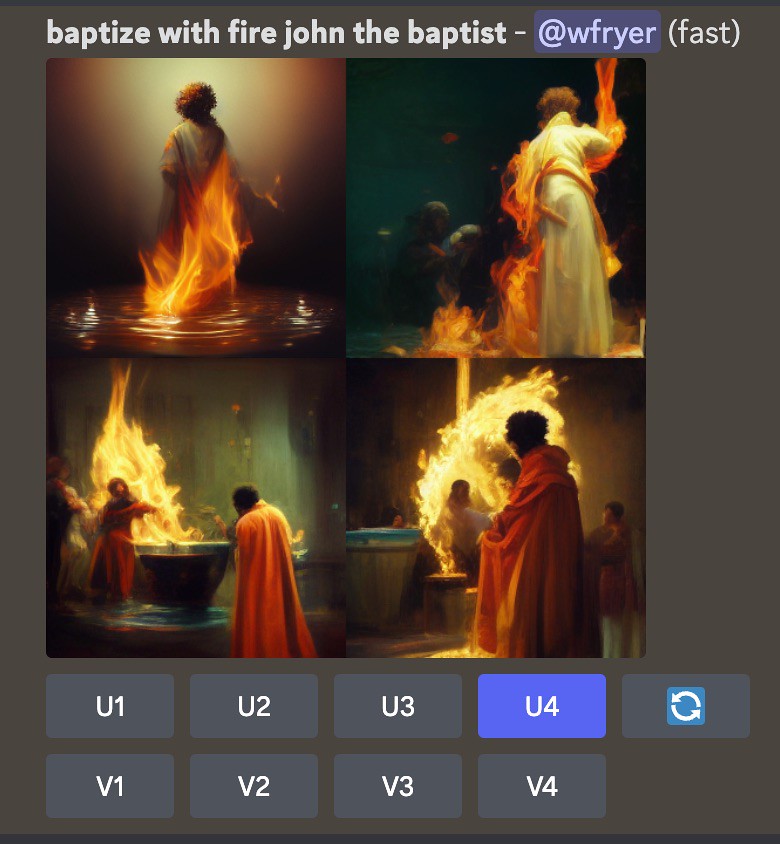
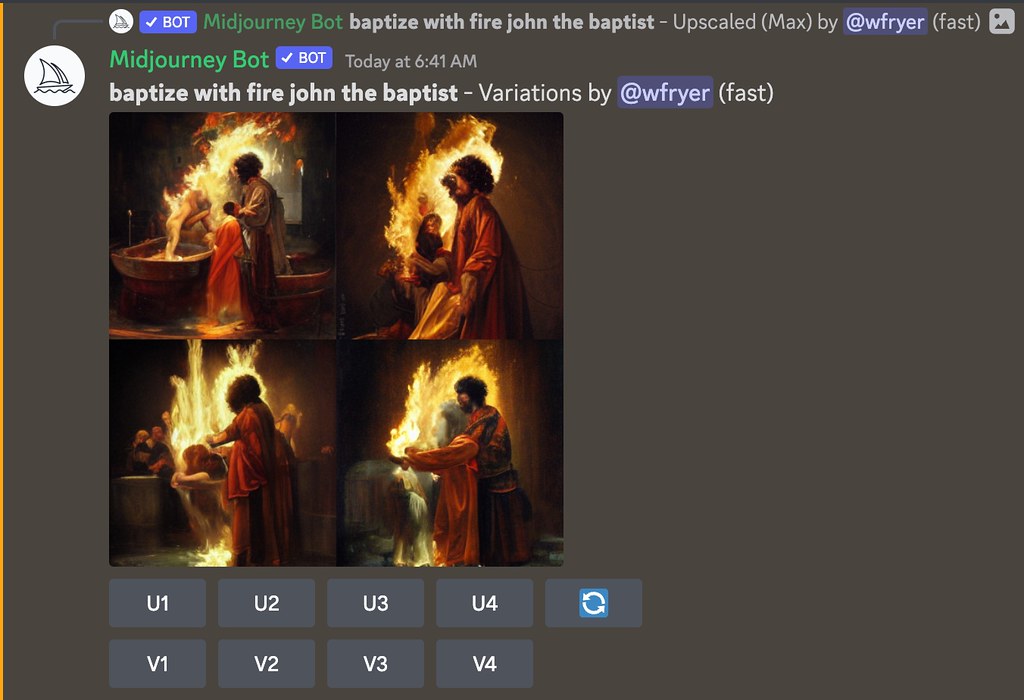
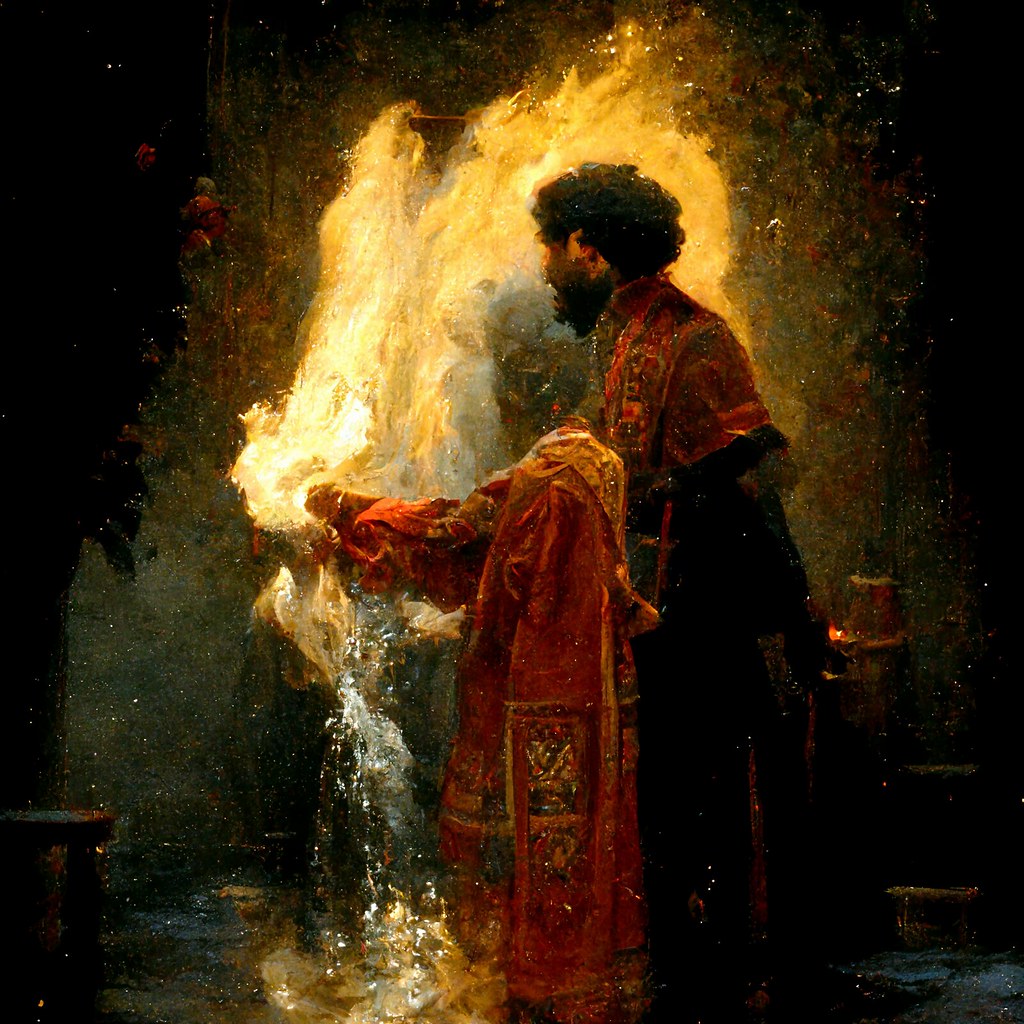
Midjourney is one of several generative AI image tools available publicly now, including DALLE-2, Stable Diffusion, and others. The Quick Start Guide to Midjourney can help get you started. You will need to setup a free account on Discord, but you can use the web-based interface if you don’t want to (or cannot) download and install the software. This was my first AI-generative image attempt, using the query, “baptize with fire john the baptist.”
During this past week’s spring break vacation, I’ve been reading a new book and re-watching episodes of the amazing TV series “The Chosen” with Shelly which have had a profound impact on my walk with Christ and our walk together through a season of tumultuous change and uncertainly. In this post I’ll share a little about these experiences.
Two weeks ago, I flew to Charlotte, North Carolina, and interviewed for a new teaching position at Providence Day School starting in August 2022. Moving to North Carolina after our youngest child’s high school graduation in June has been our ardent prayer as a couple for many months, so this was and is both an exciting and emotionally-laden time. I shared more about this on Facebook March 13th.
Considered by many to be the “mother church” of the region, St. Peter’s Episcopal Church was the first Episcopal Church in Charlotte, organized in 1834 and recognized as a parish in the Diocese of North Carolina in 1844. Area churches including St. Martin’s, Holy Comforter, St. Mark’s, St. Michaels, St. Paul’s in Monroe, and Christ Church all trace their roots to St. Peter’s.
I am about halfway through the book now, and am REALLY enjoying the “deep dive” which authors Borg and Crossan provide into the Gospel of Mark. I’ve focused most of my own Gospel-specific study and Sunday School class lessons (back when we attended Westminster Presbyterian Church in Lubbock, Texas) on the Gospel of John, and to a lesser extent the Gospel of Matthew. Last fall when I was teaching our adult Sunday School class at FPC Edmond, “Finding Jesus in Media,” we used videos from “The Bible Project” as well as multiple Bible translations and interpretations to dive deeper into Matthew’s Gospel. But until the last couple weeks, I haven’t spent as much time studying the Gospel of Mark.
One of many things which the book’s authors are encouraging me to reflect on more deeply is the theological construct of “Substitutionary atonement.” This is a very familiar theological idea to me, having grown up in the Presbyterian church and “Reformed tradition” of churches and pastors strongly influenced by Martin Luther and The Protestant Reformation. It’s interesting to read Mark’s Gospel with greater attention and see its emphasis on Jesus’ invitation to all his disciples to join him on “the way” which leads to Jeruselum.
Reading #TheLastWeek is encouraging me to think more deeply about the theological construct of “substitutionary atonement,” versus the emphasis of the Gospel writers of Mark on joining Jesus on THE WAY, the journey to Jerusalem. /5 #Lentpic.twitter.com/xtXju9bfkD
This is the journey we’re invited to take during the season of Lent, which culminates in Holy Week and Easter. I’m not sure I’d thought as much about how Jesus invites his disciples to not merely WITNESS his confrontations with the Roman and Jewish church authorities during Passover in Jerusalem, but ultimately JOIN HIM in participating in this confrontational series of events that culminates in his arrest, crucifixion, resurrection, and ultimately ascension into heaven.
Jesus does not call us to merely be PASSIVE OBSERVERS. Jesus calls us to be active participants with him in our faith, our journey of faith together to the cross and ultimately to God Himself. This is a journey of sacrifices, faith, and persistence despite frustrations and many reasons to both be seized by fears and turn aside.
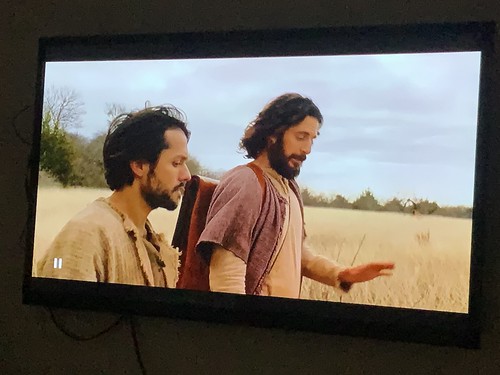
In addition to reading “The Last Week,” I’ve also enjoyed re-watching the first two episodes of “The Chosen” this week (Season 2) with Shelly. We watched the entire series together last year, but it’s amazing how many details as well as “broad strokes” of the television series I either missed or am just seeing again now “with fresh eyes.”
I LOVE how the series writers are providing such a “deep dive” into the personalities and individual characteristics of the disciples, as well as Jesus himself. Based on the Gospels and the other books of The New Testament, the script writers, actors, and others involved in the creation of these films have created a RICH media tapestry that is both insightful and challenging to us as followers of Jesus and students of his life. I have particularly enjoyed the relational dynamics between Peter and Matthew, as well as Phillip and Matthew. Seeing the series a second time has encouraged me to “see” and think more deeply about the past experiences and perspectives of different disciples, considering how each one had been uniquely prepared by God for the work they eventually were called to do with Jesus and for Jesus after his resurrection.
The scene at the end of Season 2, Episode 2, when Nathaniel first encounters Jesus and is called by Jesus to follow him (thanks in part to the friendship with and guidance of Phillip) spoke to me particularly loudly today.
I can relate directly to Nathaniel’s story of being alone, at “the end of my rope,” calling out to God for aid, assistance, comfort and direction. That is a personal story I am not going to share here right now, but perhaps will some day. It can be both powerful and emotional to see threads of “our own stories” in the Bible narratives, and to understand a little deeper how God has and continues to work through our lives to bring us closer to Him and to places where we can choose to follow His commands. To respond to His invitations. To “join Him on THE WAY.”
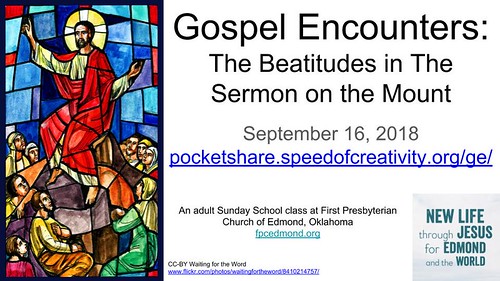
Did you identify with anyone’s expressed views in the film? If so, who and what resonated with you?
Was it surprising to learn that the top question people would ask God is, “Why is there pain and suffering in the world?” What would be some of the questions you’d ask God?
In what ways can you identify with any of the stories in The Curiosity Collective? What did you find intriguing or compelling?
On a scale of 1 to 10, how difficult is it for you to reconcile the existence of both suffering and God (1 = easy; 10 = impossible)? Why?
One of the Pulse speakers noted, “Some of the best lessons I’ve learned in life . . . came from very painful times.” In what ways might good come from bad? Do you have any experience with this?
If there’s a God, why do you think he allows evil in the world?
In the video, what did you think of James’s suggestion that God “understands our suffering . . . [and] is seeking to heal it”?
Recommended videos and resources related to our topic today include:
I am flying tonight from Oklahoma City to Raleigh, North Carolina, to share three presentations at their statewide educational technology conference. I started re-reading the Gospel of Luke tonight, and was reminded of our church’s presentation of the musical “One Incredible Moment” as I read the story of Zechariah. I don’t think I remember the story of Anna, which also is shared by Luke in the second chapter:
There was also a prophet, Anna, the daughter of Penuel, of the tribe of Asher. She was very old; she had lived with her husband seven years after her marriage, and then was a widow until she was eighty-four. She never left the temple but worshiped night and day, fasting and praying. Coming up to them at that very moment, she gave thanks to God and spoke about the child to all who were looking forward to the redemption of Jerusalem. (Luke 2:36-38 NIV)
I am practicing my sketchnoting skills (feeble as they are) with a new iPad stylus (the Paper53 “pencil”) and the iPad app Paper53. I don’t like it as well as ProCreate, but since it is free (ProCreate is not) and I’m sharing a presentation on visual notetaking this week, I decided to practice a bit. I can’t get the “undo” function of the app to work, so some of the unintended smudges I made on this drawing persist. I do like the watercolor brush though, and will likely use it more in some Sketchnotes I’ll make at the conference this week.
I pray God will give me faith to believe in the truth and goodness of his promises, and not doubt them as Zechariah did when the angel Gabriel foretold the birth of his son, John.
Zechariah asked the angel, “How can I be sure of this? I am an old man and my wife is well along in years.” The angel said to him, “I am Gabriel. I stand in the presence of God, and I have been sent to speak to you and to tell you this good news. And now you will be silent and not able to speak until the day this happens, because you did not believe my words, which will come true at their appointed time.” (Luke 1:18-20 NIV)