There are many things I do not like about Facebook and Meta, but one of them is that if you’re trying to leave a comment on someone’s post, but you need to look up a link, often when you go back Facebook auto-refreshes and you lose the post. I’ve just wasted 15 minutes of my life looking for an original post on a friend’s Facebook feed, sharing an article about “how empathy is now considered a sin by some in our political culture.” So I’m just going to post my comment here.
Please don’t mistake the announcements and opinions of Pete Hegseth or other “Christian UNnationalists” for a legitimate religion or faith. They are political manipulators seeking power, antichrists masquerading as angels of light. For help on this subject, I recommend reading Brad Onishi’s new book “American Caesar: How Theocrats and Our Tech Lords Are Turning America into a Monarchy.”
I know it’s strong language, but it’s also true: Beware of false prophets, antichrists masquerading as angels of light.
““Beware of false prophets, who come to you in sheep’s clothing but inwardly are ravenous wolves. You will know them by their fruits. Are grapes gathered from thorns or figs from thistles? In the same way, every good tree bears good fruit, but the bad tree bears bad fruit. A good tree cannot bear bad fruit, nor can a bad tree bear good fruit. Every tree that does not bear good fruit will be cut down and thrown into the fire. Thus you will know them by their fruits.”
“For such boasters are false apostles, deceitful workers, disguising themselves as apostles of Christ. And no wonder! Even Satan disguises himself as an angel of light. So it is not strange if his ministers also disguise themselves as ministers of righteousness. Their end will match their deeds.”
“Children, it is the last hour! As you have heard that antichrist is coming, so now many antichrists have come. From this we know that it is the last hour. They went out from us, but they did not belong to us, for if they had belonged to us they would have remained with us. But by going out they made it plain that none of them belongs to us.”
“Beloved, do not believe every spirit, but test the spirits to see whether they are from God, for many false prophets have gone out into the world. By this you know the Spirit of God: every spirit that confesses that Jesus Christ has come in the flesh is from God, and every spirit that does not confess Jesus is not from God. And this is the spirit of the antichrist, of which you have heard that it is coming, and now it is already in the world.”
Today I thank the Lord for walking with me through the darkest valleys of my life, for lifting me up and bringing people into my life who have shown me love and kindness. They taught and continue to teach me the value of community and extended family. I thank God that She works in and through me today, by the power of Her Holy Spirit and the teachings of Her Son, Jesus Christ.
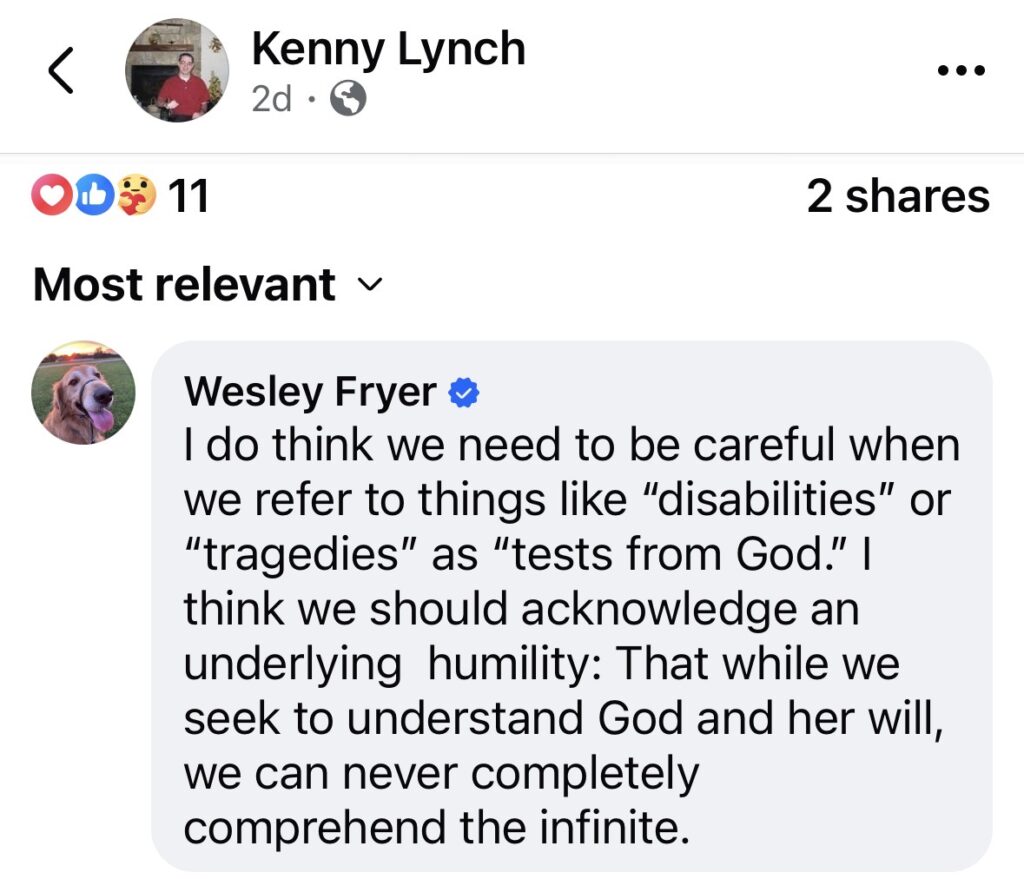
This was my response this morning to a lengthy Facebook post by a fellow graduate of Manhattan High School:
I do think we need to be careful when we refer to things like “disabilities” or “tragedies” as “tests from God.” I think we should acknowledge an underlying humility: That while we seek to understand God and her will, we can never completely comprehend the infinite.
Tomorrow morning I’ll be leading our ACE Sunday School class at Caldwell Presbyterian through a theologically rich and timely discussion. We’re currently reading and discussing Kelly Brown Douglas’s Resurrection Hope: A Future Where Black Lives Matter, and this week we’re tackling pages 84-101, the last part of chapter two. These three sections that build on each other with personal narratives as well as historical insights: “The Implications of White Knowing,” “A Compromised Moral Imaginary,” and “Back to the Conversation.”
Our centering Bible verses are Romans 12:1-2 — “Do not be conformed to this world, but be transformed by the renewing of your mind.” I’m planning to ask different members of the class to read these two verses from three Bible versions and interpretations: The King James, The NRSVUE (New Revised Standard Version Updated Edition 2021), and The Message.
Douglas would say that renewing our minds is not merely a spiritual discipline. It is a political and epistemological act. The “moral imaginary:” the lens through which we instinctively perceive justice and injustice, can be captured. And when it is captured by an epistemology that normalizes whiteness, injustice becomes literally impossible to fully see.
As we discuss the background and backlash surrounding the teaching of US history and specifically our history and role in enslaving Africans, we’ll watch a sixty second clip from a DC Public Library interview with Nikole Hannah-Jones, beginning at the 9:27 mark, in which she states the core argument of the 1619 Project directly: What if we understood our national origins not through 1776 and its ideals, but through 1619 and the lived practice of slavery?
The class will work through how Douglas uses the 1619 Project debate as a case study in white epistemological privilege in action. The 1619 Project was labeled treasonous by the Trump Administration. At the same time, more than 100 public schools and three colleges remain named for Confederate leaders — including Nathan Bedford Forrest, first grand wizard of the Ku Klux Klan. Douglas’s point is sharp: Whose knowing gets treated as dangerous, and whose gets memorialized in stone?
That question is not abstract right now. With the 250th anniversary of the Declaration of Independence just weeks away, the 1776 Commission, which President Trump created in 2020 in direct response to the 1619 Project, President Biden rescinded on his first day in office, and President Trump revived by executive order in January 2025, is the live policy context in which this theological argument lands. We are being asked as a nation to celebrate a particular version of our founding story. Douglas asks us to consider: Whose knowing shapes that story, and whose is erased?
We’ll start our lesson with a short clip from Douglas’s own book interview in 2021, at the 25:22 mark, where she describes the “white narrative gaze” and why dismantling it is the precondition for Black lives to truly matter in this country.
Douglas grounds all of this theologically. Faith communities, she argues, are by definition accountable to a future where all people are treated as sacred. That is not a political statement. It is a claim about what resurrection hope actually requires of us. She closes the chapter clinging to that hope — “I’m not ready to pack my bags yet… but we’ll see” — and her words from the interview may be the most important thing we sit with tomorrow: “My task is to create a world where my son’s children and their children will not have to ask their parents, ‘Will Black lives ever matter?'”
For Caldwell Presbyterian, that task is ours too. We return, as always, to Romans 12:2. The work of renewing our minds continues, and tomorrow morning, we take up that work together.
Here are a few of my notes from the second 30 minutes of the panel discussion.
From Rev John Cleghorn:
Knowing what I don’t know” is an essential part of wisdom when it comes to leading and preaching.
Rev Brad Paxton shared:
I teach imagination for a living. Imagination is paying attention to what is for the sake of what may be. It’s a disciplined paying attention… When a pastor doesn’t know what to preach, they have stopped paying attention.”
Rev Shannon Kershner shared:
Your voice and who you are is who God has called into that pulpit. You do not need to try and be who you think the congregation wants you to be.
How does leadership from the pulput go wrong? What are its limits?
Humility is key. Leadership in the pulput goes wrong when we lift up our own indispensability. We must remember we are but one among many vital voices.
From Rev Shannon Kershner:
“Use Scripture as bread not stone.” An idea from feminist theology, recognizing the Word can and does nourish.
Preach in a way that is invitational. that does not back people into a corner.
From a person in the pew, via Rev Shannon Kershner:
We know you have to tell us hard things. But please tell them to us softly.
From Rev John Cleghorn:
People come to worship services for MANY reasons, it’s important that it’s not always for the sermon… “that’s just part of the buffet” which is Sunday morning worship… Learning over time to speak and preach with less absolutism…. and to listen to the congregation… “Exegeting” the Word as well as the congregation.
How can preaching help lead people through these times of significant change and anxiety?
From Rev John Cleghorn:
These are challenging and difficult times… but if we believe in a God of resurrection and new life, we must remember that ‘this too shall pass.’
Rev Brad Paxton shared:
Sankofa: To go back and reclaim… to go back and remember what the ancients survived and persevered through… With a spirit of humility we can strengthen our muscles for struggle and resistance… Hard is authorized… working from cross to resurrection.
From Rev Shannon Kershner:
I am trying not to always be reactionary to the latest thing / news… Focusing on who we have been, and how that intersects with what is happening now in the nation. It’s hard! I get tired! It’s non-stop… but we need to remember this is not new… I’ve reclaimed the ‘powers and principalities’ language. Preaching a tough and resilient hope in Jesus Christ that holds Friday, Saturday and Sunday…. Not toxic positivity, but resiliency and joy that defines who we are as followers of Jesus… The litergy is the work of the people!
An amanuensis is a person who writes or types what another dictates or copies, or signs a document on behalf of another. Learn about the origin, role and examples of amanuenses in Ancient Rome, medieval Europe and modern contexts.”
I used Claude to compose an image prompt visualizing key themes from my iPad handwritten notes, and created the image with Gemini. It took multiple iterations to correct a few spelling errors, however. (convo 1 – convo 2) This is an idea visualization concept I’m calling, an “AI Sketchnote.”
Please draft an image prompt in the style of a sketchnote in the style of Rachel Smith and Mike Rhode https://rohdesign.com/about/ for these notes about the course at Union Presbyterian Seminary in Charlotte, “Religions of the Enslaved” taught by Dr. Alphonso F. Saville, IV which I audited today in person. Use the attached photo as a basis for a sketchnote version of Dr Saville, the professor today
From a content standpoint, I was really pleased and thankful to be able to audit this particular class. As I briefly reviewed the degree program options at UPS, I wasn’t sure if their M.Div. program provided many elective options. It turns out they do, but students need to be careful to complete all core class requirements as some are offered on a rotating term schedule. Since Shelly and I participated in and completed the “Confronting Whiteness Course” created by Rev. Dr. Ben Boswell, I’ve been much more aware of my own need to deepen my understanding of the ways ideas of white supremacy, race and racism, and white privilege shaped and continue to shape my life as well as the culture in which we live. I’m looking forward to joining our church’s Anti-Racism Council this spring, and continuing my own journey of listening, learning, studying, and striving to live with a deeper understanding and greater sensitivity to the ways conceptions of race shape our lives together.
I’m not sure I am called to attend seminary at this point, but God has placed this question on my heart so I will continue to discern the right path forward for me and for our family together. I would love to teach “Media Literacy for Pastors” at a seminary like UPS, but I don’t think my Ph.D. in Curriculum and Instruction is an adequate credential for that professorial role. I do know that I want to continue working as a “culture healer, not a culture warrior.”
It will be both interesting and exciting to see where that path will lead next.
Several years ago, when Shelly and I were working and teaching at Casady School in Oklahoma City, Father Tim Sean Youmans shared the television series “The Chosen” with our community multiple times via short video clips in his chapel talks. Since then, Shelly and I have watched all the episodes of “The Chosen,” which includes five seasons and will eventually total seven. I’ve used many clips from it in adult Sunday School classes I’ve taught as well as men’s Bible study lessons, and we’ve re-watched multiple episodes together at home. We LOVE “The Chosen” and highly recommend it.
In this fraught environment, I LOVE the opportunity to spend some time in the evening watching “The Chosen.” I’m not burying my head in the sand, I”m staying aware news and current events, but I’m also NOT going to watch news channels constantly when I’m not working or teaching. I watched my dear Grammy, my mom’s mom, fill her mind all day long with news from CNN, and most evenings with UFO conspiracy theories on the radio from “Art Bell Coast to Coast.” Repeated exposure to media has a powerful effect on our minds, and it’s vital that we’re proactive and intentional with the media we choose to consume.
If you love Jesus or are just interested in Jesus and would like to learn more about his life and ministry on our planet, I encourage you to watch “The Chosen.” It’s free to watch, you can download the app for AppleTV, Roku, FireTV, Android, etc. Or just watch it online in your web browser.
It’s a decision I’m confident you’ll be happy you made.
Reverend Dot Killian shared a sermon today at Caldwell Presbyterian Church in Charlotte, North Carolina, titled “Children of the Resurrection.” She preached on Luke 20:27-40:
‘Some of the Sadducees, who say there is no resurrection, came to Jesus with a question. “Teacher,” they said, “Moses wrote for us that if a man’s brother dies and leaves a wife but no children, the man must marry the widow and raise up offspring for his brother. Now there were seven brothers. The first one married a woman and died childless. The second and then the third married her, and in the same way the seven died, leaving no children. Finally, the woman died too. Now then, at the resurrection whose wife will she be, since the seven were married to her?” Jesus replied, “The people of this age marry and are given in marriage. But those who are considered worthy of taking part in the age to come and in the resurrection from the dead will neither marry nor be given in marriage, and they can no longer die; for they are like the angels. They are God’s children, since they are children of the resurrection. But in the account of the burning bush, even Moses showed that the dead rise, for he calls the Lord ‘the God of Abraham, and the God of Isaac, and the God of Jacob.’ He is not the God of the dead, but of the living, for to him all are alive.” Some of the teachers of the law responded, “Well said, teacher!” And no one dared to ask him any more questions. ‘
I’ve been using ChatGPT 5 frequently now to quickly generate “Alt Text” for images I share online. This is the ALT TEXt it generated this afternoon for my sketchnote:
Colorful hand-drawn sketchnote titled “Children of the Resurrection” by Reverend Dot Killian, with caldwellpresby.org written underneath. Across the page are bright words, arrows, and cartoon figures summarizing a Christian sermon about resurrection.
On the left, a speech bubble asks “What comes NEXT?” above a simple human figure. Nearby are the questions “Is there RESURRECTION?” and “By what AUTHORITY do you teach?” next to a yellow cross labeled Luke 20: 27–40 and an open blue Bible. Below, red stick figures and a photo of interlocking gears are labeled “The Sadducees – determinism, no angels, no resurrection.” The Caldwell Presbyterian Church logo appears in the lower left corner.
Dominating the center is the word “JESUS” in large purple letters with notes: “Answers with a QUESTION,” “Points to Exodus 3,” and a small drawing of the Torah and the burning bush. Nearby, bright lettering reads “PRESENT tense!” and a vertical phrase “LIFE after DEATH” with a purple arrow curving downward into “LIFE.” A yellow face with X-eyes and a globe are surrounded by the phrase “is NOT just a continuation of our EARTHLY LIFE.”
At the bottom center, a gray cartoon person points upward beside the words “LOOK to our LIVES for evidence of resurrection.” To the right, a record-shaped spiral and musical notes accompany the phrase “Look to the RECORD of our lives!”
On the upper right, a failing “GRADE F North Carolina BAR” card contrasts with a green “South Carolina BAR PASS” card, with a red arrow labeled “A story of resurrection NEW LIFE.” The bottom right shows a screenshot of the Bible text from Luke 20 (NRSV) with “they cannot die anymore, because they are like angels and are children of God, being children of the resurrection” underlined, and the word “HOPE!” in huge red letters. In the top right corner it says “11/9/2025 #sketchnote by wesfryer.com.”
During the years of COVID and those that followed, I not only resigned from leadership in our wonderful Friday Morning Men’s Group at FPC Edmond, after 15 years of attendance and participation, I also stepped down as an adult Sunday School teacher from a class and community we absolutely LOVED… and our family decided to leave that church entirely and try to find another congregation… which both believed and followed Jesus Christ in greater alignment with how we understood Him (and God’s Holy Spirit) to call us to live. The simple slogan of Grace Church of Yukon, Oklahoma, summarized a big part of what we found ourselves running TO in making these significant changes in our church communities: “God’s love is for EVERYONE. There are no exceptions.”
I am trying to choose all my words here with care and intention, because Shelly and I LOVE and still CARE FOR so many people we had to leave behind at FPC Edmond. We raised all three of our children in that church, and had SO many powerful and transformative experiences together there over the years.
I felt more connected to our church family there through my friendships and experiences with our Friday Morning Men’s Group than any other organization, so it was both excruciatingly difficult for me to leave / step down from leadership as well as CLEAR that this was the path I had to follow in late 2021… along with our family.
It turns out, the struggles I faced with brothers and sisters in Christ who became politicized and strident in their political views at church were not unique. Tim Alberta shares SO MANY stories of Christians and Christian churches facing similar circumstances, and I find his perspectives to be both instructive and clarifying.
I want to share my recommendation for Tim’s book in this post as well as a series of resources and organizations Tim references which remind me of my current passion projects, “Heal Our Culture” and “Resist and Heal.” It is abundantly clear to me that the voices and roles of Christian pastors in the United States have and continue to play a significant role in our present political pickle. As I write this three days before the “No Kings 2 Protests” nationwide on Saturday, October 18, 2025, which promises to be the largest day of political protest in our nation’s history, I believe we already are in the midst of “a slow civil war” (as Jeff Sharlet calls it, in another book I highly recommend) and unfortunately will face additional waves of political violence.
We need to find paths forward, to maintain our hope and joy in the face of difficult circumstances… but also to serve God on this earth with the time and resources we have been given. I believe we need to “Heal Our Culture,” and it turns out many other people and organizations do too.
Tim highlights the work of Curtis Chang, who (among other professional work) is the founder of Redeeming Babel. The homepage explains the project’s focus and mission:
Clarity in a Confusing World Christians are called to serve as signposts to the coming Kingdom of God, when Jesus will finally repair all brokenness. In a culture afflicted by division and confusion – a condition depicted by the story of Babel in Genesis 11:1-9 – Redeeming Babel equips Christians to navigate the chaos with timeless Biblical truths.
For pastors & people who know there’s a better way The intersection of faith and politics doesn’t have to be messy. Our free video course will give you an on-the-ground, biblically based approach to navigating today’s challenging political environment.
This course reminds me of “Confronting Whiteness,” a 9 week course Shelly and I experienced about 2 years ago and opened up for us a rich and important array of voices, perspectives, books and films. In the past few months I’ve been helping the founder of Confronting Whiteness, Rev Ben Boswell, start a podcast which will be launching this month, and completed facilitator training for the course earlier this year. I’m interested in learning more about “The After Party” and taking the course myself, hopefully with others.
These are all topics about which I have a deep interest. While the Heal Our Culture project is explicitly secular, I’m growing more aware of the opportunity as well as responsibility my past identity as a Christian evangelical provides for me to advocate and work for the redemption of Christian evangelicals and mainline Protestant church congregations more generally. That is work the people and organizations I’ve linked to in this post are committed to as well.
So I wanted to pass along these links and recommendations!
This evening I watched YouTube independent journalist Johnny Harris’ outstanding video, “Why the Mormon Church is So Rich,” and it has prompted me to reflect on a number of things. The video is 70 minutes long, has been online for just 3 days, and already has over 1.6 million views. Johnny Harris’ YouTube channel has over 7 million subscribers, and includes not only interesting and engaging content, but also world-class videography. I highly recommend the channel and this most recent video specifically about the Mormon Church.
My deepest intersection with Mormonism, the Church of Jesus Christ of Latter Day Saints, and members of the Mormon church came in undergraduate pilot training at Reese Air Force Base in Lubbock, Texas in 1993-94. Growing up my parents had some close Mormon friends, and I remember them showing us some of their “prepper supplies,” including lots of grain they could grind into flour at-need in hidden barrels serving as tables in their living room. One of my older UPT classmates was/still is Mormon, and a few months into our friendship they had me over to dinner at their house on base. He was married with a couple of kids, and they had also invited the local Mormon missionaries over to eat with us and after dinner, “share the pitch” about Joseph Smith, Mormonism, etc, and give me a copy of the Book of Mormon. I did read some of it, but having been raised as a midwestern USA Presbyterian, I was skeptical and my inquiries into their faith did not ultimately lead to a change in my denominational affiliation.
This encounter was influential in some of the dramatic events in my life in 1994, but I’m not going to share about those in this post.
What I will share is my opinion that Johnny Harris is remarkably courageous and brave to not only take the journey of the past decade away from the high-control / obedience-focused Mormon religion and culture, but also to SHARE that journey and so many insights through this most recent video specifically. I am thankful for his authenticity and for the window he provides into his own life and identity, but also the remarkable and influential history as well as current role of the LDS church in the United States and our world.
“Straight White American Jesus” has been one of my favorite podcasts for the past couple of years. (There are more, of course, I have a list.) I was fortunate to NOT grow up in a “high-control evangelical Christian” church and family. I attended and completed “Communicants Class” as an 8th grader at the First Presbyterian Church of Manhattan, Kansas, and while we certainly read the Bible, learned important stories and lessons from it, I remember us also being invited and welcomed to BRING OUR QUESTIONS about God and faith to class and to church. This was true throughout my church experiences growing up and at home with our family. I am very thankful for this.
At the end of his video, Johnny shares the following reflection (at 67:20) about growing up in the Mormon church, and how he thinks about those influences and their impact on his life and identity:
That [being raised in ‘a very high commitment, high control religion’] did a number on my mind and the minds of a lot of us who have had the courage to take the story back, to redefine our worthiness and our value away from the story that we were told. To define that worthiness based on what is inside of us and not on loyalty and compliance with the rules of a corporate organization that made us believe that it had the authority to tell us who we are.
Those are super-deep and super-important thoughts.
I also believe we have, as human beings, inherent “worth” and “worthiness” not based on our membership or non-membership in a particular group or tribe… but based on our humanity. As a follower of Jesus and student of the Christian Bible, I believe we were each created in the image of God, our Creator, and as God’s creations we are uniquely and individually both gifted and worthy.
How many people have been “scarred” and are being wounded today by high-control religion? The Jesus I’ve learned about and to know over 55 years, through reading the Bible as well as living life with other followers of Jesus, never advocated for an authoritarian, high-control faith or religion. Those elements of “religion” and “denomination” have been added by people (sadly mostly white guys) who have sought to impose hierarchy and obedience by mandate rather than through the ways of Jesus: Stories and invitations of love.
Give “Why the Mormon Church is So Rich” a watch and see what you think. I have known some wonderful folks who are Mormons and members of other “high-control” Christian churches and denominations. But I also know a lot of folks who embrace a much more liberating and empowering understanding of God, Jesus Christ, and the Holy Spirit. I’m thankful for all these experiences and perspectives.
‘But strive first for the kingdom of God and his righteousness, and all these things will be given to you as well. ‘