There are many things I do not like about Facebook and Meta, but one of them is that if you’re trying to leave a comment on someone’s post, but you need to look up a link, often when you go back Facebook auto-refreshes and you lose the post. I’ve just wasted 15 minutes of my life looking for an original post on a friend’s Facebook feed, sharing an article about “how empathy is now considered a sin by some in our political culture.” So I’m just going to post my comment here.
Please don’t mistake the announcements and opinions of Pete Hegseth or other “Christian UNnationalists” for a legitimate religion or faith. They are political manipulators seeking power, antichrists masquerading as angels of light. For help on this subject, I recommend reading Brad Onishi’s new book “American Caesar: How Theocrats and Our Tech Lords Are Turning America into a Monarchy.”
I know it’s strong language, but it’s also true: Beware of false prophets, antichrists masquerading as angels of light.
““Beware of false prophets, who come to you in sheep’s clothing but inwardly are ravenous wolves. You will know them by their fruits. Are grapes gathered from thorns or figs from thistles? In the same way, every good tree bears good fruit, but the bad tree bears bad fruit. A good tree cannot bear bad fruit, nor can a bad tree bear good fruit. Every tree that does not bear good fruit will be cut down and thrown into the fire. Thus you will know them by their fruits.”
“For such boasters are false apostles, deceitful workers, disguising themselves as apostles of Christ. And no wonder! Even Satan disguises himself as an angel of light. So it is not strange if his ministers also disguise themselves as ministers of righteousness. Their end will match their deeds.”
“Children, it is the last hour! As you have heard that antichrist is coming, so now many antichrists have come. From this we know that it is the last hour. They went out from us, but they did not belong to us, for if they had belonged to us they would have remained with us. But by going out they made it plain that none of them belongs to us.”
“Beloved, do not believe every spirit, but test the spirits to see whether they are from God, for many false prophets have gone out into the world. By this you know the Spirit of God: every spirit that confesses that Jesus Christ has come in the flesh is from God, and every spirit that does not confess Jesus is not from God. And this is the spirit of the antichrist, of which you have heard that it is coming, and now it is already in the world.”
This was my response this morning to a lengthy Facebook post by a fellow graduate of Manhattan High School:
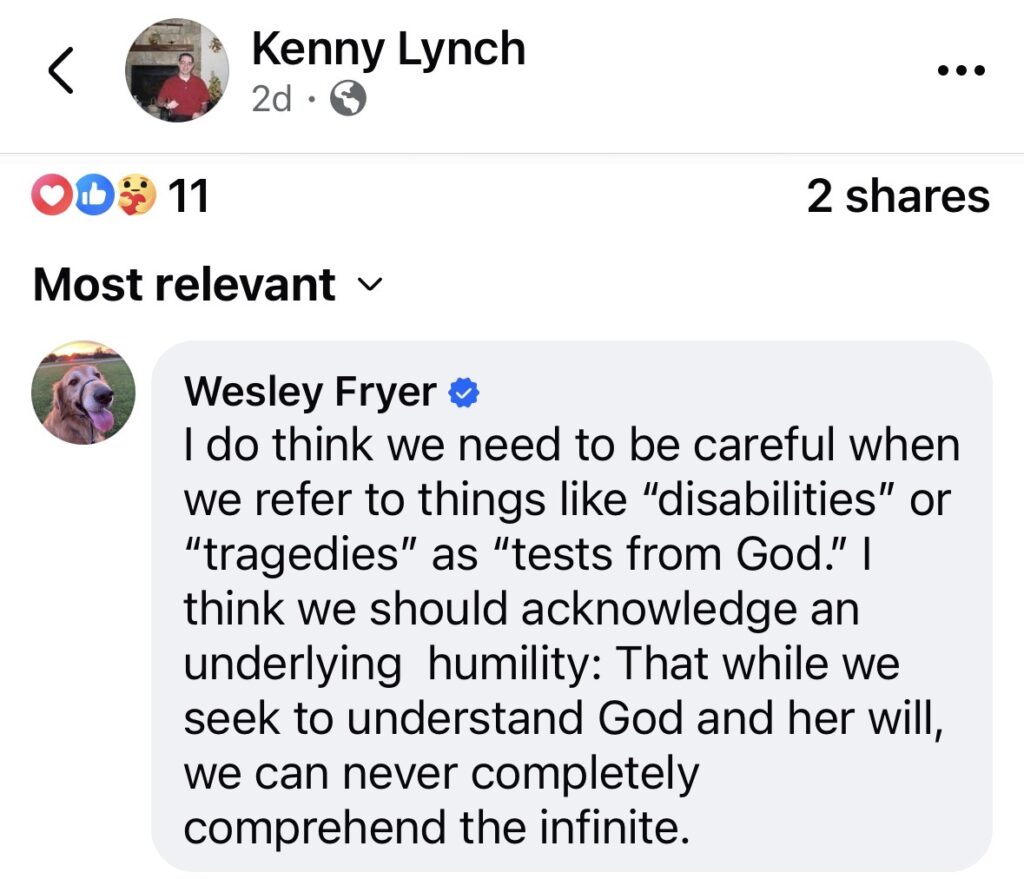
I do think we need to be careful when we refer to things like “disabilities” or “tragedies” as “tests from God.” I think we should acknowledge an underlying humility: That while we seek to understand God and her will, we can never completely comprehend the infinite.
An amanuensis is a person who writes or types what another dictates or copies, or signs a document on behalf of another. Learn about the origin, role and examples of amanuenses in Ancient Rome, medieval Europe and modern contexts.”
I used Claude to compose an image prompt visualizing key themes from my iPad handwritten notes, and created the image with Gemini. It took multiple iterations to correct a few spelling errors, however. (convo 1 – convo 2) This is an idea visualization concept I’m calling, an “AI Sketchnote.”
Please draft an image prompt in the style of a sketchnote in the style of Rachel Smith and Mike Rhode https://rohdesign.com/about/ for these notes about the course at Union Presbyterian Seminary in Charlotte, “Religions of the Enslaved” taught by Dr. Alphonso F. Saville, IV which I audited today in person. Use the attached photo as a basis for a sketchnote version of Dr Saville, the professor today
From a content standpoint, I was really pleased and thankful to be able to audit this particular class. As I briefly reviewed the degree program options at UPS, I wasn’t sure if their M.Div. program provided many elective options. It turns out they do, but students need to be careful to complete all core class requirements as some are offered on a rotating term schedule. Since Shelly and I participated in and completed the “Confronting Whiteness Course” created by Rev. Dr. Ben Boswell, I’ve been much more aware of my own need to deepen my understanding of the ways ideas of white supremacy, race and racism, and white privilege shaped and continue to shape my life as well as the culture in which we live. I’m looking forward to joining our church’s Anti-Racism Council this spring, and continuing my own journey of listening, learning, studying, and striving to live with a deeper understanding and greater sensitivity to the ways conceptions of race shape our lives together.
I’m not sure I am called to attend seminary at this point, but God has placed this question on my heart so I will continue to discern the right path forward for me and for our family together. I would love to teach “Media Literacy for Pastors” at a seminary like UPS, but I don’t think my Ph.D. in Curriculum and Instruction is an adequate credential for that professorial role. I do know that I want to continue working as a “culture healer, not a culture warrior.”
It will be both interesting and exciting to see where that path will lead next.
Reverend Dot Killian shared a sermon today at Caldwell Presbyterian Church in Charlotte, North Carolina, titled “Children of the Resurrection.” She preached on Luke 20:27-40:
‘Some of the Sadducees, who say there is no resurrection, came to Jesus with a question. “Teacher,” they said, “Moses wrote for us that if a man’s brother dies and leaves a wife but no children, the man must marry the widow and raise up offspring for his brother. Now there were seven brothers. The first one married a woman and died childless. The second and then the third married her, and in the same way the seven died, leaving no children. Finally, the woman died too. Now then, at the resurrection whose wife will she be, since the seven were married to her?” Jesus replied, “The people of this age marry and are given in marriage. But those who are considered worthy of taking part in the age to come and in the resurrection from the dead will neither marry nor be given in marriage, and they can no longer die; for they are like the angels. They are God’s children, since they are children of the resurrection. But in the account of the burning bush, even Moses showed that the dead rise, for he calls the Lord ‘the God of Abraham, and the God of Isaac, and the God of Jacob.’ He is not the God of the dead, but of the living, for to him all are alive.” Some of the teachers of the law responded, “Well said, teacher!” And no one dared to ask him any more questions. ‘
I’ve been using ChatGPT 5 frequently now to quickly generate “Alt Text” for images I share online. This is the ALT TEXt it generated this afternoon for my sketchnote:
Colorful hand-drawn sketchnote titled “Children of the Resurrection” by Reverend Dot Killian, with caldwellpresby.org written underneath. Across the page are bright words, arrows, and cartoon figures summarizing a Christian sermon about resurrection.
On the left, a speech bubble asks “What comes NEXT?” above a simple human figure. Nearby are the questions “Is there RESURRECTION?” and “By what AUTHORITY do you teach?” next to a yellow cross labeled Luke 20: 27–40 and an open blue Bible. Below, red stick figures and a photo of interlocking gears are labeled “The Sadducees – determinism, no angels, no resurrection.” The Caldwell Presbyterian Church logo appears in the lower left corner.
Dominating the center is the word “JESUS” in large purple letters with notes: “Answers with a QUESTION,” “Points to Exodus 3,” and a small drawing of the Torah and the burning bush. Nearby, bright lettering reads “PRESENT tense!” and a vertical phrase “LIFE after DEATH” with a purple arrow curving downward into “LIFE.” A yellow face with X-eyes and a globe are surrounded by the phrase “is NOT just a continuation of our EARTHLY LIFE.”
At the bottom center, a gray cartoon person points upward beside the words “LOOK to our LIVES for evidence of resurrection.” To the right, a record-shaped spiral and musical notes accompany the phrase “Look to the RECORD of our lives!”
On the upper right, a failing “GRADE F North Carolina BAR” card contrasts with a green “South Carolina BAR PASS” card, with a red arrow labeled “A story of resurrection NEW LIFE.” The bottom right shows a screenshot of the Bible text from Luke 20 (NRSV) with “they cannot die anymore, because they are like angels and are children of God, being children of the resurrection” underlined, and the word “HOPE!” in huge red letters. In the top right corner it says “11/9/2025 #sketchnote by wesfryer.com.”
This evening I watched YouTube independent journalist Johnny Harris’ outstanding video, “Why the Mormon Church is So Rich,” and it has prompted me to reflect on a number of things. The video is 70 minutes long, has been online for just 3 days, and already has over 1.6 million views. Johnny Harris’ YouTube channel has over 7 million subscribers, and includes not only interesting and engaging content, but also world-class videography. I highly recommend the channel and this most recent video specifically about the Mormon Church.
My deepest intersection with Mormonism, the Church of Jesus Christ of Latter Day Saints, and members of the Mormon church came in undergraduate pilot training at Reese Air Force Base in Lubbock, Texas in 1993-94. Growing up my parents had some close Mormon friends, and I remember them showing us some of their “prepper supplies,” including lots of grain they could grind into flour at-need in hidden barrels serving as tables in their living room. One of my older UPT classmates was/still is Mormon, and a few months into our friendship they had me over to dinner at their house on base. He was married with a couple of kids, and they had also invited the local Mormon missionaries over to eat with us and after dinner, “share the pitch” about Joseph Smith, Mormonism, etc, and give me a copy of the Book of Mormon. I did read some of it, but having been raised as a midwestern USA Presbyterian, I was skeptical and my inquiries into their faith did not ultimately lead to a change in my denominational affiliation.
This encounter was influential in some of the dramatic events in my life in 1994, but I’m not going to share about those in this post.
What I will share is my opinion that Johnny Harris is remarkably courageous and brave to not only take the journey of the past decade away from the high-control / obedience-focused Mormon religion and culture, but also to SHARE that journey and so many insights through this most recent video specifically. I am thankful for his authenticity and for the window he provides into his own life and identity, but also the remarkable and influential history as well as current role of the LDS church in the United States and our world.
“Straight White American Jesus” has been one of my favorite podcasts for the past couple of years. (There are more, of course, I have a list.) I was fortunate to NOT grow up in a “high-control evangelical Christian” church and family. I attended and completed “Communicants Class” as an 8th grader at the First Presbyterian Church of Manhattan, Kansas, and while we certainly read the Bible, learned important stories and lessons from it, I remember us also being invited and welcomed to BRING OUR QUESTIONS about God and faith to class and to church. This was true throughout my church experiences growing up and at home with our family. I am very thankful for this.
At the end of his video, Johnny shares the following reflection (at 67:20) about growing up in the Mormon church, and how he thinks about those influences and their impact on his life and identity:
That [being raised in ‘a very high commitment, high control religion’] did a number on my mind and the minds of a lot of us who have had the courage to take the story back, to redefine our worthiness and our value away from the story that we were told. To define that worthiness based on what is inside of us and not on loyalty and compliance with the rules of a corporate organization that made us believe that it had the authority to tell us who we are.
Those are super-deep and super-important thoughts.
I also believe we have, as human beings, inherent “worth” and “worthiness” not based on our membership or non-membership in a particular group or tribe… but based on our humanity. As a follower of Jesus and student of the Christian Bible, I believe we were each created in the image of God, our Creator, and as God’s creations we are uniquely and individually both gifted and worthy.
How many people have been “scarred” and are being wounded today by high-control religion? The Jesus I’ve learned about and to know over 55 years, through reading the Bible as well as living life with other followers of Jesus, never advocated for an authoritarian, high-control faith or religion. Those elements of “religion” and “denomination” have been added by people (sadly mostly white guys) who have sought to impose hierarchy and obedience by mandate rather than through the ways of Jesus: Stories and invitations of love.
Give “Why the Mormon Church is So Rich” a watch and see what you think. I have known some wonderful folks who are Mormons and members of other “high-control” Christian churches and denominations. But I also know a lot of folks who embrace a much more liberating and empowering understanding of God, Jesus Christ, and the Holy Spirit. I’m thankful for all these experiences and perspectives.
‘But strive first for the kingdom of God and his righteousness, and all these things will be given to you as well. ‘
At 4:07 of the sermon, Ben specifically addresses the misinterpretation which many Christians have maintained historically about the radical vision which the Apostle Paul had and shared for “the beloved community,” including his views on gender and relationships among people. Ben did this by starting with a discussion about baptism and the traditions of baptism in the early church. Here is what Ben said, starting at 4:07:
[04:07] And I know that Paul, you know, is not the person many of us would think of when it comes to a liberative vision of sexuality or gender. In fact, in liberal circles, Paul has a bad reputation for being rather conservative on matters of the household.
But the problem was never really just Paul himself, but his interpreters. Paul was certainly not perfect by any means and he got it quite a bit wrong. But I believe he also gets a bad rap because of the way theologians who came after him used his name to promote a reality that was the opposite of his vision.
[04:47] Only half the letters in the New Testament bearing Paul’s name were actually even written by Paul. And one could argue that Paul’s perspective on gender, ethnicity, and social status was so radical that a concerted effort was made after his death to appropriate his name and reinforce more patriarchal visions of the household and the church.
[05:13] Today, there are multitudes of fascists calling themselves Christian that are still constantly misinterpreting Paul. Some even work for the government.
[05:24] And I know that Howard Thurman’s grandmother would not allow Paul to be read in her presence because of the way his words had been used by slaveholders against her.
But there is also another Paul—the egalitarian Paul—who said, “There is no longer Jew or Greek, no longer slave or free, no longer male or female.” Paul was one of the first leaders to try to live out the radical teachings of Jesus in community with real people and to analyze that experience in writing, through the letters he wrote to churches he had visited.
[06:03] No wonder it was messy. It was the first time they were trying this all out. And if we give Paul a little bit of grace, we can see in his writings that the vision is there. His implementation may have been flawed at times, but the radical gospel vision of beloved community and new creation is clear and present in his letters.
Part of our difficulty in receiving Paul’s teachings is that we don’t really understand the culture and what it was like at the time Paul was writing. We tend to place our present-day culture—of the 21st century—back onto Paul, which is not just unfair, it obscures the radicality and the power of his vision.
Ben goes on to discuss the very hierarchical and sexist (“misogynistic”) value system of Aristotle, and how it was widely accepted by both Greek and Roman cultures. Ben makes the case that some of those INTERPRETING the letters and words of the Apostle Paul deliberately misrepresented his vision so it was SUPPORTIVE of hierarchy and misogyny, rather than radical and liberating. At 8:47 Ben said:
[08:47] Aristotle’s household code sounds nearly identical to the Victorian social norms that we all grew up in as part of the culture—especially if we came from the South. Amen.
But what is fascinating is that in this passage, and also in the whole book of Galatians, Paul—who would have known Aristotle’s arguments intimately—turned them all upside down. Paul completely reimagines the household in light of Christ. Instead of an exclusive, oppressive, patriarchal hierarchy, everyone is included. Everyone is equal. Everyone is one.
[09:24]Paul’s vision is so radical and liberative, one scholar called it the Magna Carta of Christian equality.
It’s clear today that, for the most part, the church chose to follow the patriarchal lead of Aristotle and Paul’s interpreters instead of Paul himself—is it not?
[09:42] But we also know from history that there were communities of Christians who followed Paul’s liberatory vision of a new creation.
These ideas are SO important to think about, pray about, and understand.
Christian heresy has always been a part of the landscape of faith, religion, spirituality, and Christian teaching. This is, in part, why most Christian churches establish procedures and requirements for individuals to become pastors and church leaders. There are and have (apparently) always been folks who claim (without pedigree or formal religious education) that God has spoken to them through his Holy Spirit… and they are able to accurately discern God’s Word and God’s Will. I do believe that God speaks through his Holy Spirit… He has throughout history, and He continues to do so.
But I also believe it is VERY valuable for us to seek guidance, instruction, and inspiration from Christian leaders who HAVE dedicated themselves to the study and analysis of Holy Scripture. I believe Rev Ben Boswell is a “trusted voice” when it comes to better understanding the Bible and the liberating Gospel of Jesus Christ. I am thankful for this clarifying message from last Sunday, and the opportunity to reflect on how the God of the universe is a LOVING God for all people… and this radical vision is as needed today in 2025 as it was when Jesus walked the earth as a human being.
Frequently in the Gospels of the Bible, we hear Jesus call himself, “The Son of Man.” The December 2018 video from The Bible Project, “Why Jesus Called Himself the Son of Man,” provides an outstanding overview of how Jesus’ use of this phrase references the Old Testament book of Daniel and foretells the roles he will play in both “defeating the forces of evil / darkness” (the “beast”) on earth, and ultimately rule with God and the Holy Spirit, as a co-equal part of the Holy Trinity which we understand as “God: Three in One.” The video presents important yet sometimes confusing theology in an effective, animated storytelling style. In this post, I’d like to reflect a bit more on this video specifically as well as the Bible Project videos more generally. The video is just 6 minutes long, and I encourage you to check it out and watch it first:
I first learned about The Bible Project from Tim Sean Youmans, at the time (and currently) the head Vicar (priest) at Casady School in Oklahoma City, the Episcopal Day School where I worked and served in various roles for 7 years, from 2015 to 2022. My first blog reference to “The Bible Project” dates to October 2018, in my post, “Gospel Encounter: The Last Supper (Matthew 26:17-35).” Tim Sean is the author of “Blessed to Bless: An Introduction to the Bible,” which is used a guiding text in Bible classes taught at Casady. Father Youmans would often use Bible Project videos in the homilies and messages he shared with students, faculty and staff at Casady.
My wife, Shelly, has always been an extremely discerning and spiritual follower of Jesus, and has taught me a great deal over our 28 years of marriage about Biblical values like love, grace, forgiveness, humility, sacrifice, and service. Shelly has been using videos from “The Bible Project” more recently in her own morning devoitions, and she shared the video, “Why Jesus Called Himself the Son of Man,” about a week ago with me via text.
As you may know, I’m a confessing “digital over-sharer” In my life. Slowly over time, in part due to encouragement from my spiritual director, Curt Gruel, I’ve become a more “integrated person” when it comes to my spiritual / Jesus-following / “Sunday morning side” and my “rest of the week” / more secular / professional educator side. This is reflected in several ways, including the ways I now share different kinds of media (most often “Bible Verse InfoPics.”) via the different social media channels I maintain.
Sharing a simple hyperlink can be a powerful and potentially TRANSFORMATIVE act. I credit Tim Sean Youmans with not only introducing Shelly and I, and eventually our FPCE adult Sunday School class, to The Bible Project, but also to the absolutely INCREDIBLE TV series, “The Chosen,” which is soon about to release Season 4. Those videos continue to shape my own understanding and visualization of the characters and narratives in The Bible / Holy Scripture, but also the faith journey of (at least) one of our own children, who has been particularly captivated by watching the series this past year.
I encourage you to not only watch the 6 minute video, “Why Jesus Called Himself the Son of Man,” from The Bible Project, but also check out more of the resources from bibleproject.com. Download the YouVersion Bible app and explore the words of Holy Scripture through its well designed interface, using multiple translations and interpretations of the Bible in your languages of choice. I also encourage you to SHARE these resources and your own experiences with them.
The words of God, expressed in the Holy Bible, are powerful and can be transformative in our lives. We live in an era of challenges and opportunities, and it is vital that we focus our minds DAILY on the words and messages of Jesus Christ, to maintain our hope in a world filled with dangers, fears and perils.
I pray God will bless you this day. I know God continues to bless me through my wife and spouse, Shelly, in many ways… Including the ways she shares helpful resources that assist me in my ongoing journey to deepen my relationship with and understanding of Almighty God. To God be the glory!
This Sunday is the celebration of the holiday of Epiphany, which in Christian traditions celebrates “the visit of the Magi, the baptism of Jesus, and the wedding at Cana.” Rev Killian reminded us that as a society and in our culture, “We also follow stars!” Whether pop stars like Taylor Swift of Beyoncé, or sports starts like NFL or NBA athletes, we often pay an undue amount of attention to these “stars.” However, it’s important to consider, “Where are those stars leading?” Who and what are these stars attempting to “point us to” in our lives? Where do these stars lead? By encouraging us to consider “Whose star we are following?” Rev Killian powerfully juxtaposed the sermon text from Matthew 2:1-12 with ominous headlines from contemporary news and popular culture.
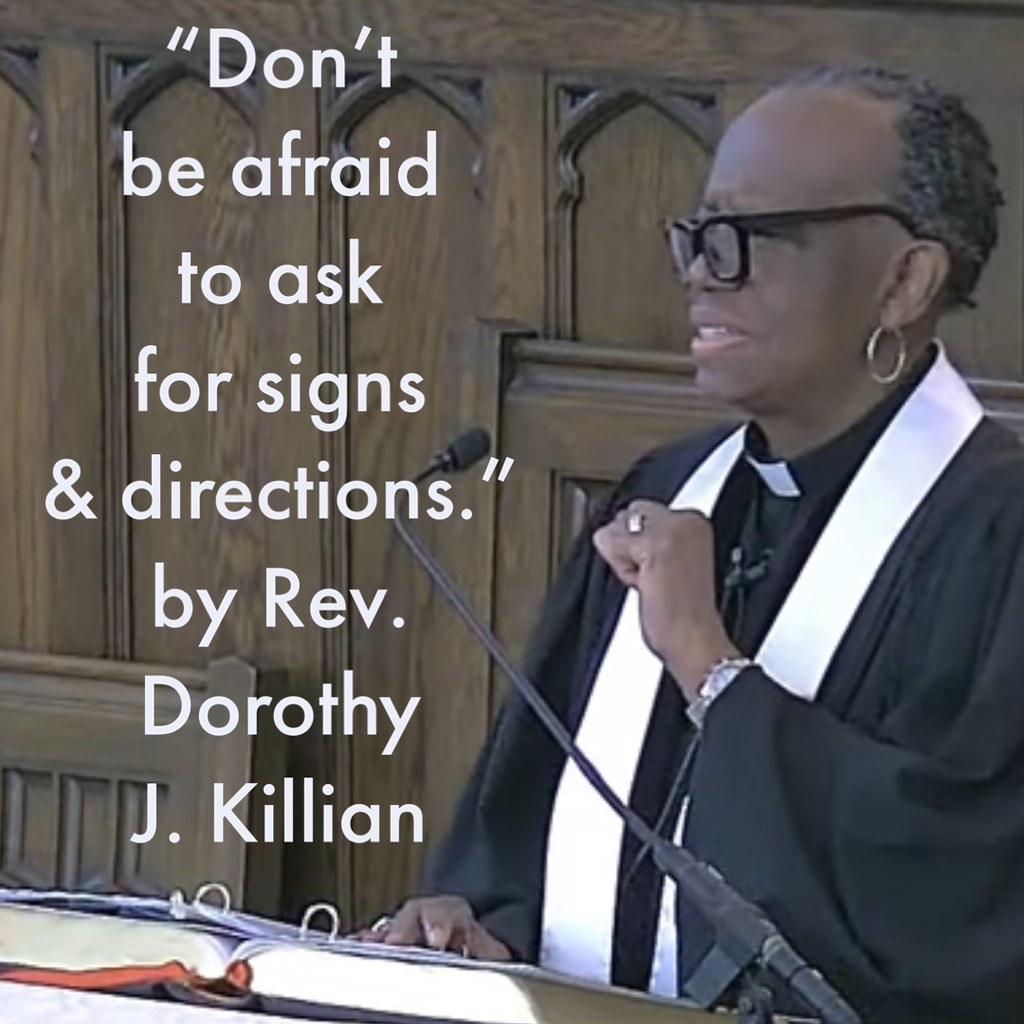
Rev Killian encouraged us to “NOT be afraid to ask for signs & directions.” We should be continually watchful for God, for He is present and at work all around us! We can see God in the beauty and wonder of His creation, but also in the ways we love and care for each other in this troubled world. God calls us to invite his Holy Spirit to provide us with directions for our lives, and he provides guidance when we seek Him in prayer, through Bible study, and through fellowship with other Christian followers of Jesus Christ.
Rev Killian received applause during her sermon when she pulled out an “old school” paper map, and reminded the congregation, “When we encounter the living God, we reset our GPS.” Whether we are using analog or digital tools to find our way in the world. encounters with God can have a powerful and positive re-directing and “re-orienting” influence on us. As an undergraduate geography major and someone who grew up learning about maps and orienteering in Boy Scouts as well as in Air Force survival training at the Air Force Academy, this analogy really resonated with me!
I also loved Rev Killian’s encouragement to “Look for God and listen for His voice.” For over 10 years now, I’ve been blessed to participate in “Spiritual Direction” with Curt Gruel, through HeartPaths OKC. Even after we moved to North Carolina in 2022, my monthly meetings with Curt have continued via Zoom! “Spiritual Direction” is all about “looking for God,” and meeting with a mentor who can help us identify, see, and interpret “God sightings” in our lives. This is an important message every day, but seems particularly appropriate as we start 2024 and a new calendar year with different ideas for resolutions and new habits to adopt.
Rev Killian’s final exhortations were to ask “Who are the ‘Herods’ in your life? Who is sowing fear in your journey of faith and life?” As I consider the ways I want to develop the “Heal Our Culture” project in the weeks and months ahead, these questions are both challenging and prescient. There are many voices on YouTube, in mainstream news, and in social media which encourage us to adopt a spirit of fear rather than an attitude of joy, hope, and abiding faith.
I want to follow the star of Jesus, and I’m thankful for these words of encouragement from Rev Killian today!
Through the YouVersion Bible app for iPhone, Shelly (my wife) has discovered the “Eyewitness Bible Series” of videos. This morning, on her recommendation, I watched the 11.5 minute video, “Topics 07 Gratitude,” which features the Biblical character Cornelius the Centurion. In this post, I want to reflect a bit on the theme of “human hierarchy” and how we are called to REJECT it as a “cultural norm.” This is vital to understand as a follower of Jesus Christ. This links directly to two books I have read (or listened to on Audible) in recent years, and I’ll also share some links to past posts reflecting on these themes more deeply.
Here’s the “BIG BIBLICAL IDEA” I took away from this excellent video as well as my (relatively) recent related theological readings: Through Jesus Christ, God calls us to reject the human hierarchies imposed and enforced by authorities and cultural influencers. As we read in the closing verses of the third Chapter of Galatians, written by the Apostle Paul:
‘There is neither Jew nor Gentile, neither slave nor free, nor is there male and female, for you are all one in Christ Jesus. So in Christ Jesus you are all children of God through faith, for all of you who were baptized into Christ have clothed yourselves with Christ. If you belong to Christ, then you are Abraham’s seed, and heirs according to the promise. Before the coming of this faith, we were held in custody under the law, locked up until the faith that was to come would be revealed. So the law was our guardian until Christ came that we might be justified by faith. Now that this faith has come, we are no longer under a guardian.
Rejecting the cultural norm of “hierarchies” is both challenging and radical. Most societies “teach” that hierarchies are real, natural, and should be both expected and embraced. The Gospel of Jesus Christ, however, rejects this. Throughout history, including the Jewish faith and the Christian faith, however, we see how many church authorities and leaders have MISSED this critical idea and value from Jesus, Instead, these “authorities” have worked to impose hierarchy and establish it as a universally accepted constant. As a follower of Jesus Christ, however, I understand that perspective to be heresy / heretical.
I’ll try to explain what I mean.
In this context, when I speak of “hierarchy” I’m talking about a perception or understanding that human beings are NOT equal and should not be accorded equal treatment. This is a cultural value in most human societies. In the infamous words George Orwell from Animal Farm, “All animals are equal, but some animals are more equal than others.” Orwell was literally writing about animals, but he was metaphorically explaining hierarchy in human as well as animal societies / communities. Hierarchy is common and often accepted, even when it is (often) oppressive and destructive to the goal of human flourishing.
According OxfordReference.com: hierarchy is:
A type of social organization in which individuals are ranked according to their status or dominance relative to other group members. This affects their behaviour in various ways, e.g. by determining their access to food or to mates. Many vertebrate animals and some invertebrates live in hierarchical social groups.
Although Jesus Christ taught his disciplines to love one another without regard to hierarchical status or privilege, human authorities relatively quickly moved to co-opt Christianity, make it a “state religion,” and pervert it so it enforced rather than dissolved hierarchical divisions and separations in society. 2 years ago, for fun, I read Paul Stephenson’s 2010 book, “Constantine: Unconquered Emperor, Christian Victor,” I wrote a lengthy reflection about the book and things I learned from it, titled, “Lessons about Constantine & Ancient Rome.” As I highlighted and attempted to explain in that post, these ideas relate directly to conceptions of “Christian Nationalism” and the ways we see Christianity continue to be perverted and mis-represented in contemporary U.S. politics.
As a follower of Jesus Christ and a student of the Bible seeking to be led by God’s Holy Spirit, I understand that:
God does not condone or support the enslavement of human beings.
God does not bless or endorse the oppression of women, or the patriarchal discrimination of women by men.
Here’s my main connection to this book and the topic of hierarchy in the Christian faith: As followers of Jesus, we are NOT called to be disciples of oligarchy or hierarchy. As disciples of Jesus Christ, we are called to view every human being on our planet as a child of God, a unique and miraculous creation of our Heavenly Father both deserving of love as well as every right and privilege as everyone else. We are all sinners, and all fall short of the grace of God. We all stand as equals, WITHOUT DIFFERENTIATING HIERARCHY, before the throne of God.
”But now apart from the law the righteousness of God has been made known, to which the Law and the Prophets testify. This righteousness is given through faith in Jesus Christ to all who believe. There is no difference between Jew and Gentile, and all are justified freely by his grace through the redemption that came by Christ Jesus. God presented Christ as a sacrifice of atonement, through the shedding of his blood—to be received by faith. He did this to demonstrate his righteousness, because in his forbearance he had left the sins committed beforehand unpunished—“
Here’s one final reflection, returning to the words of Paul in Galatians 3. In verse 23 we read, “nor is there male and female, for you are all one in Christ Jesus.” Let’s consider what that means in the context of our ongoing culture wars in the United States. There is an enormous focus by some political actors on hierarchies based on gender and sexual preference. Those individuals and groups repeatedly preach a false and heretical gospel of hierarchy and condemnation of fellow citizens and human beings on our planet. Those voices proclaiming these divisions and perspectives, “endorsing hierarchical values,” do NOT speak for God or Jesus Christ. Rather, they are false prophets, and need to be called out as such.
”But there were also false prophets among the people, just as there will be false teachers among you. They will secretly introduce destructive heresies, even denying the sovereign Lord who bought them—bringing swift destruction on themselves. Many will follow their depraved conduct and will bring the way of truth into disrepute. In their greed these teachers will exploit you with fabricated stories. Their condemnation has long been hanging over them, and their destruction has not been sleeping.“
Go in peace. My God’s Holy Spirit fill our hearts and minds this day, and may we all speak and act in kindness and love, representing the radical and transforming grace of Jesus Christ in a suffering world in desperate need of His embrace.
This should be obvious to all people in all modern cultures, but sadly it is not and some groups are working to “turn back the clock.
Women are full human beings and should be accorded FULL human rights. This goes for ALL people by the way. Check the Universal Declaration of Human Rights if you or someone you know is unclear about this:
Both in secular and religious contexts, women have full rights (just as men do) to live, lead, and serve as human beings irrespective of their sexuality or gender identification. HUMAN RIGHTS. These rights are foundational, unconditional and irrevocable.
Jesus did not come to our earth, live among us for 30 years, willingly submit to crucifixion and death on a cross, and bodily resurrect from the dead so that His followers could “keep women in their place” or His followers would act as legalistic jurors presiding over tribunals on the basic rights of fellow humans.
Jesus came to our earth for many reasons, but principal among these was to teach us (as humans on this planet) how to LOVE and better care for each other. He also came to free us from the legalistic and oppressive rule of religious groups like the Pharisees, and offer us a NEW covenant based on grace, love, forgiveness and community.
It’s really quite remarkable and wonderful. We can all even read about it in our own language today!
Some Southern Baptist Protestants “need a heads up” on these topics.
Southern Baptists’ Fight Over Female Leaders Shows Power of Insurgent Right (NYTimes, 16 June 2022) – Gift Link 🎁: