Whose Knowing Counts?

Tomorrow morning I’ll be leading our ACE Sunday School class at Caldwell Presbyterian through a theologically rich and timely discussion. We’re currently reading and discussing Kelly Brown Douglas’s Resurrection Hope: A Future Where Black Lives Matter, and this week we’re tackling pages 84-101, the last part of chapter two. These three sections that build on each other with personal narratives as well as historical insights: “The Implications of White Knowing,” “A Compromised Moral Imaginary,” and “Back to the Conversation.”

Here are the slides I’ll use during our lesson and discussion, which are also linked from the “Weekly Lesson Slideshows” folder on followjesus.wesfryer.com.

Our centering Bible verses are Romans 12:1-2 — “Do not be conformed to this world, but be transformed by the renewing of your mind.” I’m planning to ask different members of the class to read these two verses from three Bible versions and interpretations: The King James, The NRSVUE (New Revised Standard Version Updated Edition 2021), and The Message.

Douglas would say that renewing our minds is not merely a spiritual discipline. It is a political and epistemological act. The “moral imaginary:” the lens through which we instinctively perceive justice and injustice, can be captured. And when it is captured by an epistemology that normalizes whiteness, injustice becomes literally impossible to fully see.

As we discuss the background and backlash surrounding the teaching of US history and specifically our history and role in enslaving Africans, we’ll watch a sixty second clip from a DC Public Library interview with Nikole Hannah-Jones, beginning at the 9:27 mark, in which she states the core argument of the 1619 Project directly: What if we understood our national origins not through 1776 and its ideals, but through 1619 and the lived practice of slavery?

The class will work through how Douglas uses the 1619 Project debate as a case study in white epistemological privilege in action. The 1619 Project was labeled treasonous by the Trump Administration. At the same time, more than 100 public schools and three colleges remain named for Confederate leaders — including Nathan Bedford Forrest, first grand wizard of the Ku Klux Klan. Douglas’s point is sharp: Whose knowing gets treated as dangerous, and whose gets memorialized in stone?

That question is not abstract right now. With the 250th anniversary of the Declaration of Independence just weeks away, the 1776 Commission, which President Trump created in 2020 in direct response to the 1619 Project, President Biden rescinded on his first day in office, and President Trump revived by executive order in January 2025, is the live policy context in which this theological argument lands. We are being asked as a nation to celebrate a particular version of our founding story. Douglas asks us to consider: Whose knowing shapes that story, and whose is erased?

We’ll start our lesson with a short clip from Douglas’s own book interview in 2021, at the 25:22 mark, where she describes the “white narrative gaze” and why dismantling it is the precondition for Black lives to truly matter in this country.

Douglas grounds all of this theologically. Faith communities, she argues, are by definition accountable to a future where all people are treated as sacred. That is not a political statement. It is a claim about what resurrection hope actually requires of us. She closes the chapter clinging to that hope — “I’m not ready to pack my bags yet… but we’ll see” — and her words from the interview may be the most important thing we sit with tomorrow: “My task is to create a world where my son’s children and their children will not have to ask their parents, ‘Will Black lives ever matter?'”

One of the VERY encouraging organizations and series of events I’ll draw to everyone’s attention, in the context of next month’s anniversary celebration of the Declaration of Independence, is the “250 Years of Resistance” webpage of The Freedom Center for Social Justice.

The image features a banner for The Freedom Center for Social Justice's "250 Years of Resistance" campaign. Below the text, a group of three people are smiling and holding LGBTQ+ progress pride flags outdoors. The right side of the graphic includes text about centering liberation, truth, and community power, alongside a URL for the campaign. The overall design advocates for liberty and justice, emphasizing that these fights are led by those who have been denied them.
250 Years of Resistance by The Freedom Center for Social Justice (CC BY 4.0) by Wesley Fryer

For Caldwell Presbyterian, that task is ours too. We return, as always, to Romans 12:2. The work of renewing our minds continues, and tomorrow morning, we take up that work together.

For more videos and podcasts with and about Kelly Brown Douglas and her book, Resurrection Hope: A Future Where Black Lives Matter, check out my post for Heal Our Culture, “Kelly Brown Douglas on Resurrection Hope.” (Also on Substack.)

The image features an inspirational quote set against a dark blue background with a silhouette of a person reading under a tree. The text, attributed to Kelly Brown Douglas from "Resurrection Hope: A Future Where Black Lives Matter," emphasizes the role of faith leaders in helping the nation embrace a more just vision. It calls upon the faith community to help forge a new social memory that moves away from white supremacist causes. The quote concludes by urging society to instead enact the vision for equality originally set forth in the Declaration of Independence.
Forging a “different social memory” (CC BY 4.0) by Wesley Fryer

Redeeming Evangelical Christians and Our Church Universal

I”m almost finished listening to Tim Alberta‘s FANTASTIC book, “The Kingdom, the Power, and the Glory: American Evangelicals in an Age of Extremism,” published in December 2023. It’s included with a “Spotify Premium” subscription, which is how I’ve been listening to it the past couple weeks.

As a follower of Jesus who now identifies as a former evangelical Christian or “ex-vangelical,” the stories Tim shares in this book connect so many dots for me. As a 15 year member (including service as an ordained deacon and elder) of First Presbyterian Church of Edmond, Oklahoma, subsequently a Christian refugee attending Saint Augustine of Canterbury Episcopal Church of Oklahoma City and Grace Church of Yukon… and now Caldwell Presbyterian Church of Charlotte, North Carolina.. I’ve struggled to understand exactly WHAT HAPPENED to many mainline Protestant Christian congregations during my adult lifetime?

During the years of COVID and those that followed, I not only resigned from leadership in our wonderful Friday Morning Men’s Group at FPC Edmond, after 15 years of attendance and participation, I also stepped down as an adult Sunday School teacher from a class and community we absolutely LOVED… and our family decided to leave that church entirely and try to find another congregation… which both believed and followed Jesus Christ in greater alignment with how we understood Him (and God’s Holy Spirit) to call us to live. The simple slogan of Grace Church of Yukon, Oklahoma, summarized a big part of what we found ourselves running TO in making these significant changes in our church communities: “God’s love is for EVERYONE. There are no exceptions.”

God Loves You. No Exceptions! (CC BY 4.0) by Wesley Fryer

I am trying to choose all my words here with care and intention, because Shelly and I LOVE and still CARE FOR so many people we had to leave behind at FPC Edmond. We raised all three of our children in that church, and had SO many powerful and transformative experiences together there over the years.

Eager Easter Egg Hunters in 2007 (CC BY 4.0) by Wesley Fryer

I felt more connected to our church family there through my friendships and experiences with our Friday Morning Men’s Group than any other organization, so it was both excruciatingly difficult for me to leave / step down from leadership as well as CLEAR that this was the path I had to follow in late 2021… along with our family.

Christmas Eve 2008 with The Wards (CC BY 4.0) by Wesley Fryer

It turns out, the struggles I faced with brothers and sisters in Christ who became politicized and strident in their political views at church were not unique. Tim Alberta shares SO MANY stories of Christians and Christian churches facing similar circumstances, and I find his perspectives to be both instructive and clarifying.

I want to share my recommendation for Tim’s book in this post as well as a series of resources and organizations Tim references which remind me of my current passion projects, “Heal Our Culture” and “Resist and Heal.” It is abundantly clear to me that the voices and roles of Christian pastors in the United States have and continue to play a significant role in our present political pickle. As I write this three days before the “No Kings 2 Protests” nationwide on Saturday, October 18, 2025, which promises to be the largest day of political protest in our nation’s history, I believe we already are in the midst of “a slow civil war” (as Jeff Sharlet calls it, in another book I highly recommend) and unfortunately will face additional waves of political violence.

We need to find paths forward, to maintain our hope and joy in the face of difficult circumstances… but also to serve God on this earth with the time and resources we have been given. I believe we need to “Heal Our Culture,” and it turns out many other people and organizations do too.

Tim highlights the work of Curtis Chang, who (among other professional work) is the founder of Redeeming Babel. The homepage explains the project’s focus and mission:

Clarity in a Confusing World
Christians are called to serve as signposts to the coming Kingdom of God, when Jesus will finally repair all brokenness. In a culture afflicted by division and confusion – a condition depicted by the story of Babel in Genesis 11:1-9 – Redeeming Babel equips Christians to navigate the chaos with timeless Biblical truths.

Along with Nancy French, Curtis is the author of “The After Party: Toward Better Christian Politics,” and the the flexible, FREE, six week course, “The After Party.” The pitch for the course is:

For pastors & people who know there’s a better way
The intersection of faith and politics doesn’t have to be messy. Our free video course will give you an on-the-ground, biblically based approach to navigating today’s challenging political environment.

This course reminds me of “Confronting Whiteness,” a 9 week course Shelly and I experienced about 2 years ago and opened up for us a rich and important array of voices, perspectives, books and films. In the past few months I’ve been helping the founder of Confronting Whiteness, Rev Ben Boswell, start a podcast which will be launching this month, and completed facilitator training for the course earlier this year. I’m interested in learning more about “The After Party” and taking the course myself, hopefully with others.

In the latest episode of “The Good Faith Podcast,” Christian conservative David French asks and answers the question, “What the Heck Is a Christian Nationalist?”

These are all topics about which I have a deep interest. While the Heal Our Culture project is explicitly secular, I’m growing more aware of the opportunity as well as responsibility my past identity as a Christian evangelical provides for me to advocate and work for the redemption of Christian evangelicals and mainline Protestant church congregations more generally. That is work the people and organizations I’ve linked to in this post are committed to as well.

So I wanted to pass along these links and recommendations!

Christmas 2015 (CC BY 4.0) by Wesley Fryer

Reflections on the Mormon Church

This evening I watched YouTube independent journalist Johnny Harris’ outstanding video, “Why the Mormon Church is So Rich,” and it has prompted me to reflect on a number of things. The video is 70 minutes long, has been online for just 3 days, and already has over 1.6 million views. Johnny Harris’ YouTube channel has over 7 million subscribers, and includes not only interesting and engaging content, but also world-class videography. I highly recommend the channel and this most recent video specifically about the Mormon Church.

My deepest intersection with Mormonism, the Church of Jesus Christ of Latter Day Saints, and members of the Mormon church came in undergraduate pilot training at Reese Air Force Base in Lubbock, Texas in 1993-94. Growing up my parents had some close Mormon friends, and I remember them showing us some of their “prepper supplies,” including lots of grain they could grind into flour at-need in hidden barrels serving as tables in their living room. One of my older UPT classmates was/still is Mormon, and a few months into our friendship they had me over to dinner at their house on base. He was married with a couple of kids, and they had also invited the local Mormon missionaries over to eat with us and after dinner, “share the pitch” about Joseph Smith, Mormonism, etc, and give me a copy of the Book of Mormon. I did read some of it, but having been raised as a midwestern USA Presbyterian, I was skeptical and my inquiries into their faith did not ultimately lead to a change in my denominational affiliation.

This encounter was influential in some of the dramatic events in my life in 1994, but I’m not going to share about those in this post.

What I will share is my opinion that Johnny Harris is remarkably courageous and brave to not only take the journey of the past decade away from the high-control / obedience-focused Mormon religion and culture, but also to SHARE that journey and so many insights through this most recent video specifically. I am thankful for his authenticity and for the window he provides into his own life and identity, but also the remarkable and influential history as well as current role of the LDS church in the United States and our world.

“Straight White American Jesus” has been one of my favorite podcasts for the past couple of years. (There are more, of course, I have a list.) I was fortunate to NOT grow up in a “high-control evangelical Christian” church and family. I attended and completed “Communicants Class” as an 8th grader at the First Presbyterian Church of Manhattan, Kansas, and while we certainly read the Bible, learned important stories and lessons from it, I remember us also being invited and welcomed to BRING OUR QUESTIONS about God and faith to class and to church. This was true throughout my church experiences growing up and at home with our family. I am very thankful for this.

At the end of his video, Johnny shares the following reflection (at 67:20) about growing up in the Mormon church, and how he thinks about those influences and their impact on his life and identity:

That [being raised in ‘a very high commitment, high control religion’] did a number on my mind and the minds of a lot of us who have had the courage to take the story back, to redefine our worthiness and our value away from the story that we were told. To define that worthiness based on what is inside of us and not on loyalty and compliance with the rules of a corporate organization that made us believe that it had the authority to tell us who we are.

Those are super-deep and super-important thoughts.

I also believe we have, as human beings, inherent “worth” and “worthiness” not based on our membership or non-membership in a particular group or tribe… but based on our humanity. As a follower of Jesus and student of the Christian Bible, I believe we were each created in the image of God, our Creator, and as God’s creations we are uniquely and individually both gifted and worthy.

How many people have been “scarred” and are being wounded today by high-control religion? The Jesus I’ve learned about and to know over 55 years, through reading the Bible as well as living life with other followers of Jesus, never advocated for an authoritarian, high-control faith or religion. Those elements of “religion” and “denomination” have been added by people (sadly mostly white guys) who have sought to impose hierarchy and obedience by mandate rather than through the ways of Jesus: Stories and invitations of love.

Give “Why the Mormon Church is So Rich” a watch and see what you think. I have known some wonderful folks who are Mormons and members of other “high-control” Christian churches and denominations. But I also know a lot of folks who embrace a much more liberating and empowering understanding of God, Jesus Christ, and the Holy Spirit. I’m thankful for all these experiences and perspectives.

‘But strive first for the kingdom of God and his righteousness, and all these things will be given to you as well. ‘

Matthew 6:33
https://www.bible.com/bible/2016/MAT.6.33

Amen.

An illustration depicting reflections on the Mormon Church, featuring a man on a video call, a depiction of a Mormon temple, two missionaries presenting a Book of Mormon to a family, and a diverse group of people discussing finances.
Reflections on the Mormon Church (CC BY 4.0) by Wesley Fryer

Resistance Narratives: Shelter Theology

Today I facilitated an adult Sunday School class discussion about “Resistance Narratives,” which is the fourth chapter of Susan J. Dunlap’s 2021 book, “Shelter Theology: The Religious Lives of People without Homes.” The ACE class at Caldwell Presbyterian Church in downtown Charlotte, North Carolina, is studying this book in advance of a visit from the author, Dr. Susan Dunlap, who lives in Durham and is on the faculty at the Duke Divinity School. Here are the slides I shared during our lesson today, along with a 30 minute summary video I recorded this afternoon after class, to share with members who were not present today as well as others online.

I created over 40 annotated photos of quotations and excerpts from Chapter 4 in preparation for today’s lesson and discussion, but just talked about six of them during class. All of those annotated photos are available in this Flickr album.

Caldwell Presbyterian Church of Charlotte is in the midst of a multi-year project they call “Easter’s Home,” which involves the conversion of the church’s old education building into a 21 apartment, permanent supportive housing facility for single adults in the Charlotte community experiencing homelessness. The need for this type of affordable / supportive housing in the Charlotte urban area is tremendous. Around 3000 adults in Charlotte are homeless each night.

After summarizing and highlighting key points from the chapter in today’s class, I shared some personal connections to the ideas and themes Dr. Dunlap raised. I talked about Positive Tomorrows, which is the non-profit and school serving families in Oklahoma City experiencing homelessness where Shelly (my wife) worked and taught for 4 years. I also shared an audio podcast Shelly recorded with her students in November 2015 at Positive Tomorrows, talking about things for which students are grateful. I didn’t have enough time to fully play the podcast in class today, but I did include it in the 30 minute summary video linked above.

In the after-class video recording, I also mentioned Storychasers and the different types of digital stories highlighted on the Storychasers “Examples” page. I did not mention, but probably should have) the “Christian Digital Storytelling” examples page I created recently. I think there are good possibilities for the ways members of the Caldwell Presbyterian community might use digital storytelling in the weeks and months ahead both to educate their own congregation about the complex issues involving people experiencing homelessness, their needs, and the respectful (as well as safe) ways members of the church community can act in service and support of these marginalized members of our community.

The last thing I will note is that I was able to share a little of my own experiences reading and studying the pedagogy of Paulo Freire, whose ideas about empowering and transforming the minds and lives of the most marginalized and oppressed members of our communities connect directly to the themes and invitations of Susan Dunlap in her book, “Shelter Theology..” In addition to studying John Dewey for a semester with Professor Doug Simpson at Texas Tech University when I was working on my PhD, I also studied Paulo Freire for a semester with Dr. Simpson. It was a challenging and motivating experience, and continues to shape my thoughts as well as aspirations on the subjects of diversity, inclusion, equity and social justice.


The Pedagogy of Paulo Freire” (CC BY 2.0) by Wesley Fryer

Biblical Interpretation and the Role of Women

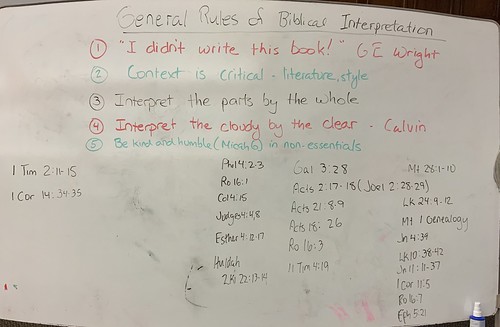
For our “Gospel Encounters” adult Sunday School class on January 27, 2019, Pastor Dave Moore led us in a verse packed overview of Biblical Interpretation and specifically a deep dive into the roles of women in the church and society, as highlighted primarily in the New Testament. These are the whiteboard notes and Bible verses from which Dave taught:

A friend of mine on Facebook had asked me some excellent questions regarding the role of women, and specifically some of the verses from Paul’s first letter to the Corinthians this past January. After seeking direction and counsel from both our lead pastor (Eric Laverentz@ericlav) as well as Dave, I recorded and shared a 10.5 minute video for him of my best understanding of these passages and the overall perspectives of Christians on the roles of women in the church.

Women have and continue to play extremely important roles of leadership, service, teaching, and prophesy in the Christian church. If you are seeking answers yourself to questions about this topic, I hope this video and the verses Dave Moore shared with our Sunday School class are helpful and instructive to you.

‘“ ‘In the last days, God says, I will pour out my Spirit on all people. Your sons and daughters will prophesy, your young men will see visions, your old men will dream dreams. Even on my servants, both men and women, I will pour out my Spirit in those days, and they will prophesy. ‘

Acts 2:17-18 (NIV)

Gospel Encounters: Sharing our Journey of Faith to Jesus

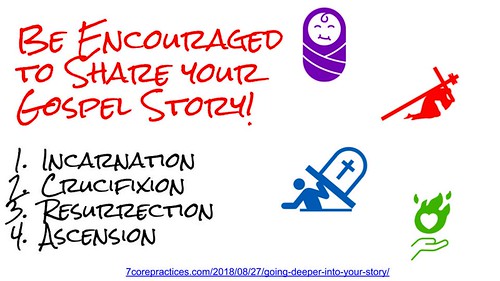
Today in our adult Sunday School class, continuing our focus on both historical and contemporary “Gospel Encounters” with Jesus, I shared my personal testimony as well as a framework for “Sharing our Journey of Faith to Jesus.” This is based on a four part framework explained on our church‘s new website, “7 Core Practices,” detailed in the post from August 2018, “Going Deeper Into Your Story.” Here are the slides I used during today’s lesson.

I referenced a video about part of my testimony which I recorded and posted to YouTube in September 2011, titled “God Answered My Prayer in Pilot Training.”

I initially wrote about this on my professional blog in August 2006, before I created this separate space as my “Christian blog.” It was initially named “Eyes Right,” before I changed it to “Pocket Share Jesus” to align with the “Digital Witness for Jesus Christ” book and evangelism empowerment project.

This was the first time I shared parts of “my story” publicly which followed the events described in the above video. Those experiences from my life in February 1994 are likely things I will never put online and share digitally, but I am glad to have an opportunity to share them in person with others with the hope and prayer they will serve as an encouragement which points others to Jesus Christ.

I hope and pray today’s lesson highlighted the ways God has and continues to be active in my life and the life of our family. I also hope it was an encouragement to us all to share our own Gospel story with others. Check out 7corepractices.com for more inspiration and practical suggestions about ways we can serve and share Jesus Christ in our homes, workplaces, and communities. Also check out www.dw4jc.com for suggestions and strategies for how we can share scripture, our stories, and our witness of God’s Holy Spirit being active in our lives using digital media.

* Added 27 October 2018: I shared a modified version of these slides, with a few photos from pilot training which I dug out of our garage, in a presentation for our Friday Morning Men’s group on October 26, 2018.

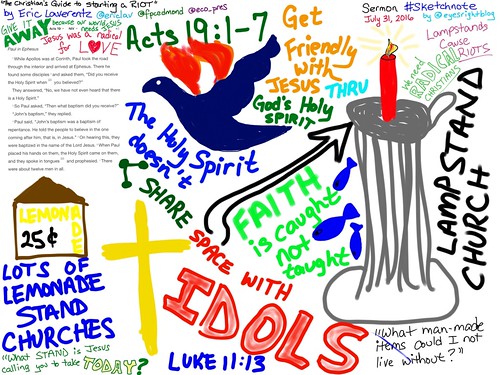
Narrated Sermon Sketchnotes on Acts 19:1-7 by Eric Laverentz

This is my sketchnote and narrated sermon sketchnotes for Eric Laverentz’ sermon at First Presbyterian Church of Edmond, Oklahoma, on July 29, 2016. Eric was nominated by our Pastor Nominating Committee to serve as our new “lead pastor,” and this was his sermon on Acts 19:1-7, right before our congregational meeting in which we voted to approve that nomination! The title of his sermon was, “The Christian’s Guide to Starting a Riot.” Eric encouraged us in the sermon to become a “Lampstand Church,” which supports members as we take meaningful stands in our culture for the Gospel of Jesus Christ. Follow Eric on Twitter at @ericlav. Eric is the author of the book, “Is Caesar Our Savior?” 

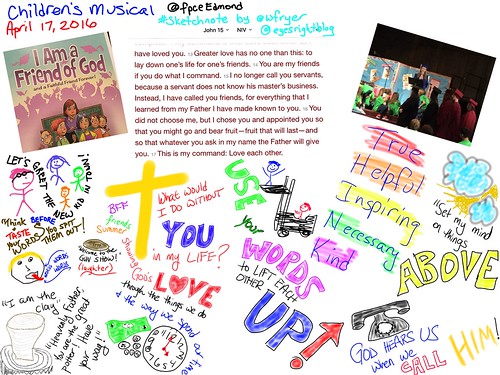
Children’s Musical Sketchnote

Kids in our church‘s Children’s Ministry Department shared a wonderful musical during our worship service today called, “I Am a Friend of God.” I created a sketchnote during the performance highlighting some of the key ideas, and also recorded a short “live clip” of the kids singing one of the songs using Ferrite Recording Studio on my iPad. I was able to import that audio clip into iMovie for iPad this evening when I recorded the accompanying voice narration. I created the sketchnote and sketchnote replay video using ProCreate.

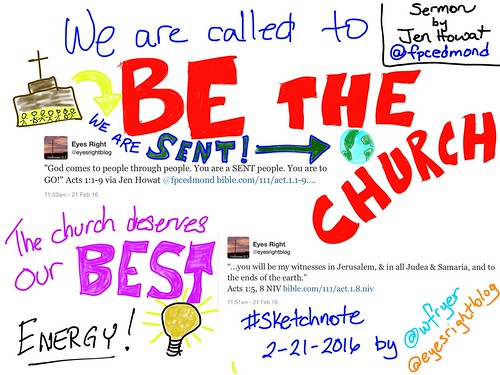
Called to BE the Church

This morning our pastor, Jen Howat, preached on Acts 1:1-9. Her sermon focused on how we are called to BE the church, which means doing the work of Jesus & not necessarily gathering in church buildings. This is my sermon sketchnote and narrated sketchnote of her sermon. I  integrated a couple tweets which I shared during the first part of the sermon.


Chapel Talk (November 2015)

I will have an opportunity tomorrow to share an eight minute chapel talk with our upper division and middle division students. These are the slides and the message I plan to share.


Created with Haiku Deck, presentation software that inspires

Chapel Talk November 5, 2015 by Wesley Fryer

Good morning.

It is both an honor and a blessing to have an opportunity today to share a few words with you in this beautiful chapel, at our wonderful school. As a relative newcomer to our Casady family, I am still very much in awe of the amazing opportunities we have together as a community to not only learn and work, but also worship and grow spiritually. When I was growing up and going to elementary, middle and high school, my family moved five times. I lived in Arizona, Colorado, Alabama, Texas, Mississippi, and Kansas before I finished the sixth grade, because my father was in the Air Force and was assigned to a new base every three to four years. Whenever we move to a new place and find ourselves in new surroundings, we slowly get used to a “new normal.” There is so much to be thankful for as a member of our Casady community, and I give God both thanks and praise for these blessings.

This morning I’d like to talk to with you about ideas that are both basic but also revolutionary. This is the reality of God’s existence, and the invitation that God extends to us through his Son, Jesus Christ, to have a relationship with him. This may sound like an overly simplistic message: After all, we are here in a Christian chapel, and some people might assume that everyone here acknowledges God’s reality and knows his only begotten son, Jesus Christ. In my life, however, I’ve learned that just because someone grows up in the church, and regularly attends church services, does not necessarily mean they believe God is real, or that they acknowledge and know his son, Jesus Christ.

If you have a Bible and can open it, I invite you to turn to the Gospel of John, in the 1st chapter, where I will read the first fourteen verses. I love all the gospels, but I particularly love the way John starts his gospel, reminding us that God has always existed, and always will exist. As finite beings, which have a mortal beginning and will have a mortal end, this is extremely hard for us to understand. Yet with God’s help and through faith, we can. In John 1 we read:

1 In the beginning was the Word, and the Word was with God, and the Word was God. 2 He was with God in the beginning. 3 Through him all things were made; without him nothing was made that has been made. 4 In him was life, and that life was the light of all mankind. 5 The light shines in the darkness, and the darkness has not overcome[a] it.

6 There was a man sent from God whose name was John. 7 He came as a witness to testify concerning that light, so that through him all might believe. 8 He himself was not the light; he came only as a witness to the light.

9 The true light that gives light to everyone was coming into the world. 10 He was in the world, and though the world was made through him, the world did not recognize him. 11 He came to that which was his own, but his own did not receive him. 12 Yet to all who did receive him, to those who believed in his name, he gave the right to become children of God— 13 children born not of natural descent, nor of human decision or a husband’s will, but born of God.

14 The Word became flesh and made his dwelling among us. We have seen his glory, the glory of the one and only Son, who came from the Father, full of grace and truth.

Thanks be to God for this reading of his Word.

As our human race has developed more knowledge and named more of the amazing dynamics which we find on our marvelous planet, some people have and continue to believe that “our need” and “the space” for God in our world has diminished or even gone away altogether. I stand before you as a witness today, however, to tell you that perspective on God is mistaken. God is very real and very present today, as he was yesterday, and as he will be tomorrow. His son, Jesus Christ, stands at the door of our hearts this day, this morning, even right now as I share these words with you, knocking and asking to come in.

While God is always present around us, sometimes we are too busy or just don’t have our eyes open to see him and the work he is doing. I’d like to close my comments today by telling you a short story, when I dramatically witnessed both the reality and the saving power of God.

After I graduated from the US Air Force Academy in Colorado Springs, I lived and studied for a year in Mexico City before starting pilot training in Lubbock, Texas. I had flown about 40 hours in the T-37, which is a twin engine sub-sonic jet aircraft, when I had my first opportunity to fly solo (by myself) to the area where we were authorized to perform a variety of aerobatic maneuvers. These included things like an aelieron roll, a split – S, an immelman, a clover leaf, and other maneuvers that I could explain better if I used my hands and you could see them clearly. I’ll summarize by saying it was very cool to be able to fly a jet by yourself up to an area of empty airspace over the plains of West Texas, between 10,000 and 25,000 feet above sea level, and have about 20 minutes worth of jet fuel to burn doing aerobatic maneuvers.

Once I got into my area on my first solo flight away from the air base’s traffic pattern, I decided that I wanted to try doing three aelieron rolls in a row. One aelieron roll was a permitted procedure, but more than one in a row in a T-37 was not. In other more aerodynamic aircraft, you can simply push the stick to one side of the cockpit and do as many rolls as you want to without losing much altitude or airspeed. In the T-37, however, it was necessary to pull your nose up 30 degrees before doing a roll, because the nose dropped during the procedure. What ended up happening to me on a February day in 1994 when I tried three consecutive aileron rolls was that I got into a nose low, inverted dive and found myself zooming toward the ground at over 250 knots of airspeed. Instead of rolling wings level and pulling back to recover, I pulled back my throttles and pulled back on my control stick. This led to a dive recovery in which I exceeded 9 G’s. I did not black out, but I did completely lose my vision as the G forces pulled the blood down out of my head. I saw my airspeed going over 250 as I lost vision, and as I applied back pressure to try and recover my plane from the dive I prayed to God that he would save me.

No one actually knows how close to the ground I came in recovering my aircraft that day, because of the delay in the radar sweep from the air traffic control center monitoring aircraft in that area. What we do know is that I was well below 10,000 feet, and the G meter on my aircraft was maxed out to over 9 G’s. The maximum allowable G’s for T-37 pilots is 6.67 G’s. I landed my aircraft, did not zero out the G meter, and reported what happened knowing that could very well have been my last flight in pilot training. It was not, I was able to continue flying and solo again to the area several weeks later, but I certainly did not try doing three consecutive aelieron rolls in that airplane again.

I am sharing a brief part of that dramatic story with you today, because it clearly dramatized to me the reality of God and how he is able to answer our prayers when we call out to him for help. In your life, if you have not already, you are going to study and work with some extremely smart people who do not believe in God or that he even exists. I am a witness who can tell you that God is not only real, but He’s present with us right now, right here, today. Whether you find yourself now in a difficult struggle or just another “normal” day of school, God is available and wants to be the co-pilot of your life.

I encourage you to seek God and pray to Him this day, not only in the difficult times, but in the good ones as well. Thanks be to God for his grace, his love to us, his children who do not deserve it, and for his son who came to teach us how to live.

God bless each one of you this day. May today be filled with kindness and joy, and may we each share the love of God with each person we meet.

1 2 3