
Black Women Who Led Our Civil Rights Movement
This Sunday, November 8, I’m facilitating our ACE adult Sunday school class at Caldwell Presbyterian Church in Charlotte. We’re working through Jemar Tisby’s book “The Spirit of Justice,” and tomorrow we’re discussing Chapter 8, “Women of the Movement.” These are some of the key takeaways from Tisby’s chapter:
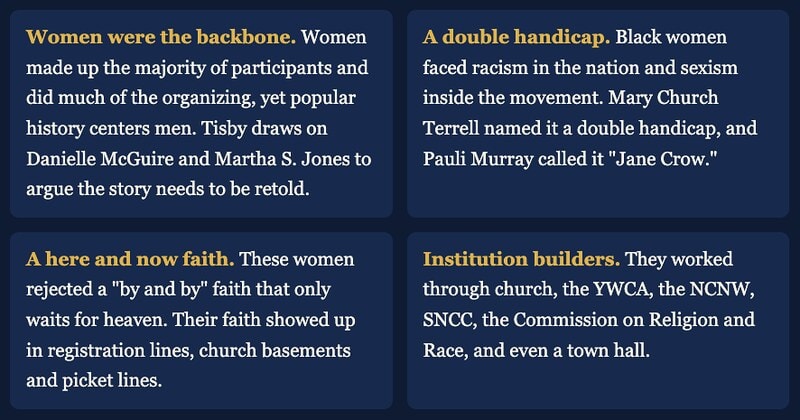
Tisby opens with Ella Baker, who knew she would never lead from the pulpit or the podium because she was a woman. Then he profiles six more whose faith put them at the center of the struggle for freedom: Coretta Scott King, Ruby Dee, Anna Arnold Hedgeman, Dorothy Height, Prathia Hall, and Unita Blackwell. To prepare for our discussion, I built a web page for our class with a short profile of each woman, a timeline of their lives, videos, a podcast conversation with Celeste Headlee about her new book Freedom’s Daughters, and discussion questions: Women of the Movement lesson resources. I shared this on my GitHub, which can be used as a free space for sharing single HTML webpages like this, as well as sharing code.
I didn’t build this webpage by myself. I gave Claude, Anthropic’s AI assistant, screenshots of the chapter (from Amazon’s Kindle Cloud Reader website) and described what I wanted. Claude drafted the profiles, pulled dates and places from published sources, and built the page. I checked the work, cut videos that didn’t fit, and removed language that was written for me as the teacher. The page also includes a fact check section, because we found places where sources disagree. Even Prathia Hall’s birth date is disputed. I think that’s a useful media literacy lesson in itself: AI can speed up the work, but people still have to verify, decide, and take responsibility for what gets shared.
Why does this matter? Tisby points out that women made up most of the movement’s participants and did much of its organizing, yet the story we usually hear centers men. Black women faced racism in the nation and sexism inside the movement. Pauli Murray called it “Jane Crow.” They kept going anyway, in church basements, voter registration lines, the YWCA, SNCC, and even a town hall. Prathia Hall called it “freedom faith,” a faith that has to be lived, not only believed.
If we only remember part of the story, we learn only part of the lesson. These women show us that faith and justice work belong together, and that much of the most important work is done by people who are rarely named from the front. I want us to ask who does that work in our own communities now, and whether we are naming them.
The timeline and interactive EVENTS section of our class lesson website is my favorite part. With so many dates and events, it’s helpful to use a timeline to make comparisons. I like the way Claude used “webpage chips” (like buttons) to filter the significant events in the lives of these six people, as well as important events overall in the civil rights movement.

Given the dramatic role of women and black women specifically in deciding the outcome of last week’s 2026 midterm elections, this lesson tomorrow seems particularly timely and important.
View on Threads
Please explore the page, share it, and tell me what you think. If you teach or lead a study group, use whatever helps.
AI Attribution: In addition to using Claude to build my lesson website, I also asked Claude to draft this blog post. I then made edits and added hyperlinks. Follow more of my learning about and with AI on ai.wesfryer.com.