
Black Women Who Led Our Civil Rights Movement

This Sunday, November 8, I’m facilitating our ACE adult Sunday school class at Caldwell Presbyterian Church in Charlotte. We’re working through Jemar Tisby’s book “The Spirit of Justice,” and tomorrow we’re discussing Chapter 8, “Women of the Movement.” These are some of the key takeaways from Tisby’s chapter:
Tisby opens with Ella Baker, who knew she would never lead from the pulpit or the podium because she was a woman. Then he profiles six more whose faith put them at the center of the struggle for freedom: Coretta Scott King, Ruby Dee, Anna Arnold Hedgeman, Dorothy Height, Prathia Hall, and Unita Blackwell. To prepare for our discussion, I built a web page for our class with a short profile of each woman, a timeline of their lives, videos, a podcast conversation with Celeste Headlee about her new book Freedom’s Daughters, and discussion questions: Women of the Movement lesson resources. I shared this on my GitHub, which can be used as a free space for sharing single HTML webpages like this, as well as sharing code.

I didn’t build this webpage by myself. I gave Claude, Anthropic’s AI assistant, screenshots of the chapter (from Amazon’s Kindle Cloud Reader website) and described what I wanted. Claude drafted the profiles, pulled dates and places from published sources, and built the page. I checked the work, cut videos that didn’t fit, and removed language that was written for me as the teacher. The page also includes a fact check section, because we found places where sources disagree. Even Prathia Hall’s birth date is disputed. I think that’s a useful media literacy lesson in itself: AI can speed up the work, but people still have to verify, decide, and take responsibility for what gets shared.

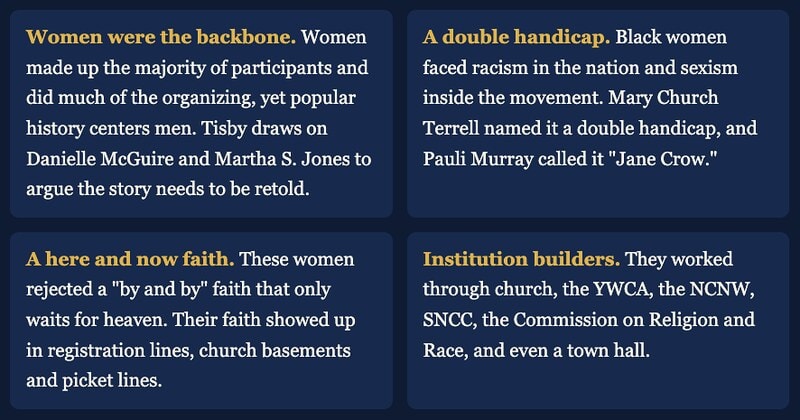
Why does this matter? Tisby points out that women made up most of the movement’s participants and did much of its organizing, yet the story we usually hear centers men. Black women faced racism in the nation and sexism inside the movement. Pauli Murray called it “Jane Crow.” They kept going anyway, in church basements, voter registration lines, the YWCA, SNCC, and even a town hall. Prathia Hall called it “freedom faith,” a faith that has to be lived, not only believed.

If we only remember part of the story, we learn only part of the lesson. These women show us that faith and justice work belong together, and that much of the most important work is done by people who are rarely named from the front. I want us to ask who does that work in our own communities now, and whether we are naming them.

The timeline and interactive EVENTS section of our class lesson website is my favorite part. With so many dates and events, it’s helpful to use a timeline to make comparisons. I like the way Claude used “webpage chips” (like buttons) to filter the significant events in the lives of these six people, as well as important events overall in the civil rights movement.

Timeline: Coretta Scott King, Ruby Dee, Anna Arnold Hedgeman, Dorothy Height, Prathia Hall, and Unita Blackwell (CC BY 4.0) by Wesley Fryer

Given the dramatic role of women and black women specifically in deciding the outcome of last week’s 2026 midterm elections, this lesson tomorrow seems particularly timely and important.

View on Threads

Please explore the page, share it, and tell me what you think. If you teach or lead a study group, use whatever helps.


AI Attribution: In addition to using Claude to build my lesson website, I also asked Claude to draft this blog post. I then made edits and added hyperlinks. Follow more of my learning about and with AI on ai.wesfryer.com.
Lessons from the Prophet Amos

These are my notes from today’s Sunday School lesson and worship service at Caldwell Presbyterian Church in Charlotte, North Carolina on January 21, 2024.

“Praying The Hours” is a Catholic prayer ritual / method one of the members of our Sunday School class uses / follows.

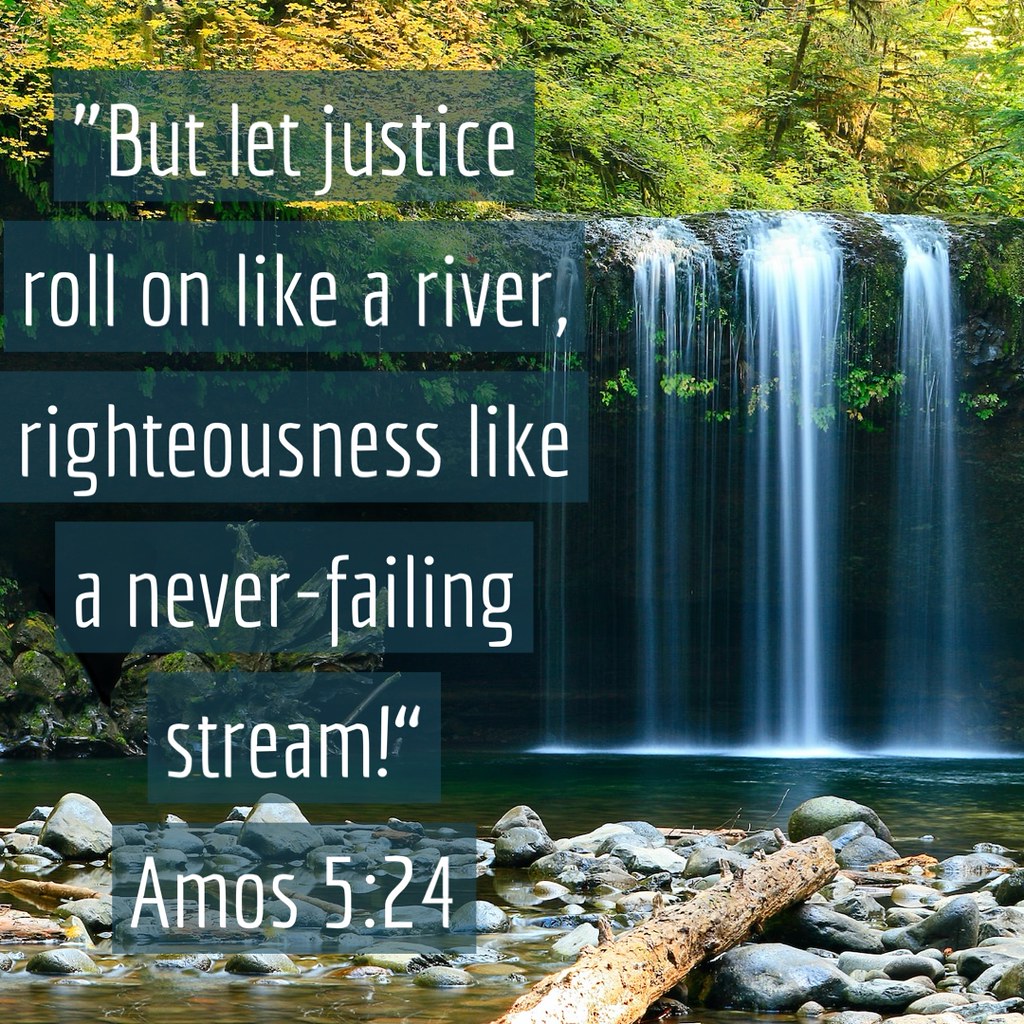
 ”Take away from me the noise of your songs; to the melody of your harps I will not listen. But let justice roll down like waters, and righteousness like an everflowing stream.“

Amos‬ ‭5‬:‭23‬-‭24‬ ‭RSV‬‬
“Let Justice Roll on like a river…” (CC BY 2.0) by Wesley Fryer

From ChatGPT 4: My prompt: “Tell me background about these Bible verses: ”Take away from me the noise of your songs; to the melody of your harps I will not listen. But let justice roll down like waters, and righteousness like an everflowing stream.“ ‭‭Amos‬ ‭5‬:‭23‬-‭24‬ ‭RSV‬‬”

ChatGPT 4’s responses:

The verses you’ve quoted, Amos 5:23-24 from the Revised Standard Version (RSV) of the Bible, are part of the Book of Amos, which is one of the books of the Minor Prophets in the Old Testament. Amos, the author, was an early prophet of Israel, active around 750-760 BCE.

These particular verses are part of a larger passage where Amos is delivering a message of judgment and warning from God to the people of Israel. The primary context here is a critique of ritualistic worship that lacks sincerity and justice. Amos is essentially telling the Israelites that God is not interested in their music and worship if they are not also pursuing justice and righteousness in their society.

Verse 23 (“Take away from me the noise of your songs; to the melody of your harps I will not listen”) indicates God’s rejection of worship that is disconnected from ethical living. In verse 24 (“But let justice roll down like waters, and righteousness like an everflowing stream”), the imagery of flowing water symbolizes the continuous and abundant practice of justice and righteousness that God desires.

This passage reflects a common theme in the prophetic books of the Old Testament, where the prophets call for social justice and true, heartfelt worship, as opposed to mere ritualistic practices. It emphasizes that religious ceremonies are meaningless to God if they are not accompanied by moral and ethical behavior, especially towards the less fortunate and marginalized in society.”

Via ChatGPT 4

How are we acting to come out of our places of privilege to:

  • Provide access to health care for those who don’t have it?
  • Where are we acting ourselves to channel God’s righteousness?

”Then the King will say to those at his right hand, ‘Come, O blessed of my Father, inherit the kingdom prepared for you from the foundation of the world; for I was hungry and you gave me food, I was thirsty and you gave me drink, I was a stranger and you welcomed me, I was naked and you clothed me, I was sick and you visited me, I was in prison and you came to me.’ Then the righteous will answer him, ‘Lord, when did we see thee hungry and feed thee, or thirsty and give thee drink? And when did we see thee a stranger and welcome thee, or naked and clothe thee? And when did we see thee sick or in prison and visit thee?’ And the King will answer them, ‘Truly, I say to you, as you did it to one of the least of these my brethren, you did it to me.’ Then he will say to those at his left hand, ‘Depart from me, you cursed, into the eternal fire prepared for the devil and his angels; for I was hungry and you gave me no food, I was thirsty and you gave me no drink, I was a stranger and you did not welcome me, naked and you did not clothe me, sick and in prison and you did not visit me.’ Then they also will answer, ‘Lord, when did we see thee hungry or thirsty or a stranger or naked or sick or in prison, and did not minister to thee?’ Then he will answer them, ‘Truly, I say to you, as you did it not to one of the least of these, you did it not to me.’ And they will go away into eternal punishment, but the righteous into eternal life.”“

‭‭Matthew‬ ‭25‬:‭34‬-‭46‬ ‭RSV‬‬

I don’t think God calls us to be overwhelmed by the enormity of needs and suffering we see in the world. I think God calls us to do the work in front of us, to do the work he has prepared in advance for us to do. We are called to walk and live in faith, that God calls us to do this work together.

Crisis Assistance Ministries

“The  mission  of Crisis Assistance Ministry is to  provide assistance  and advocacy for people in financial crisis, helping them move toward self-sufficiency.

Our  vision  is to inspire our community to justice and generosity as we provide help, hope, and understanding to people struggling with limited financial resources.”

From CrisisAssistance.org

#HealOurCulture 

Full Old Testament reading:

”“I hate, I despise your feasts, and I take no delight in your solemn assemblies. Even though you offer me your burnt offerings and cereal offerings, I will not accept them, and the peace offerings of your fatted beasts I will not look upon. Take away from me the noise of your songs; to the melody of your harps I will not listen. But let justice roll down like waters, and righteousness like an everflowing stream. “Did you bring to me sacrifices and offerings the forty years in the wilderness, O house of Israel? You shall take up Sakkuth your king, and Kaiwan your star-god, your images, which you made for yourselves; therefore I will take you into exile beyond Damascus,” says the Lord, whose name is the God of hosts.“

‭‭Amos‬ ‭5‬:‭21‬-‭27‬ ‭RSV‬‬

Consider the way Eugene Peterson expressed these ideas and sentiments of the prophet Amos:

”I can’t stand your religious meetings. I’m fed up with your conferences and conventions. I want nothing to do with your religion projects, your pretentious slogans and goals. I’m sick of your fund-raising schemes, your public relations and image making. I’ve had all I can take of your noisy ego-music. When was the last time you sang to me? Do you know what I want? I want justice—oceans of it. I want fairness—rivers of it. That’s what I want. That’s all I want.

‭‭Amos‬ ‭5‬:‭21‬-‭24‬ ‭MSG‬‬

“Justice begins with God!

Justice requires that everyone shares in the resources of our culture and community.”

by Rev. Dorothy J. Killian
“Justice begins with God” (CC BY 2.0) by Wesley Fryer

Social Justice = Full participation in society

Only when the lives of all worshippers are congruent with the ideals of God’s justice is God pleased.